
The Three Body Problem
The ‘Three Body Problem’ (in the West) refers to a particular scientific endeavour. A puzzle that historically began as a way to calculate the movement connection between the sun, moon and Earth. Today, the same thing can refer to any problem in quantum or classical mechanics that models the motion of three particles. This article however, is not about that.
“The Three Body Problem” [Chinese title: 《三体》 (Sāntǐ)] is a science-fiction novel by Chinese writer 刘慈欣 (Liú Cíxīn). This popular work was the first Asian book to win the Hugo Award for Best Novel, and was also nominated for the Nebula Award for Best Novel. This, is not about that either.
This article is about exploring the subject of 三體勢 (Sāntǐ Shì) [(the) Three Body Posture] (1), a foundational training technique in Xingyiquan. Xingyi boxers illustrate how much they value it with this saying (my translation);
「三劈不如一站」 (Sān pī bùrú yī zhàn)
[ [Practicing] three [lots of] Pī [Quán]
is [still] not the equal of a single [session of] standing.]
This is quite the compliment, as Pī Quán is often spoken of as the root of all their forms.

The idea of Sāntǐ Shì is to stand in a specific way for an extended time. Recommended practice durations vary, with the 車 (Chē) style (found in the Shānxī province branch of Xingyiquan) suggesting only five to ten minutes at a time, whereas the Héběi province styles tend to emphasize standing over longer periods of time (an hour every day (minimum) is quite common). Stories of the early Xingyiquan teachers requiring a new student to practice only standing for the first three years before they will teach anything else, is also not unheard of. These days it is still common to hear the phrase (my translation);
百日站樁 (Bǎi rì zhàn zhuāng)
[Hundred days [of] Standing [like a] Post]
As to why practice standing at all, if we greatly simplifying the subject, we can reduce the plethora of reasons down to two main ones;
- Training the mind. With a meditative mindset it can be considered; 立禪 (Lì Chán) [Standing Meditation]. The mental aspect additionally trains determination / will power, in part due to having to focus through the body’s discomfort feedback.
- Training the body in an isometric fashion. The physical aspect helps develop better connection, and alignment in the body’s structure, as well as physically strengthening muscles that keep the hands up, and the body’s root strong.
Origins
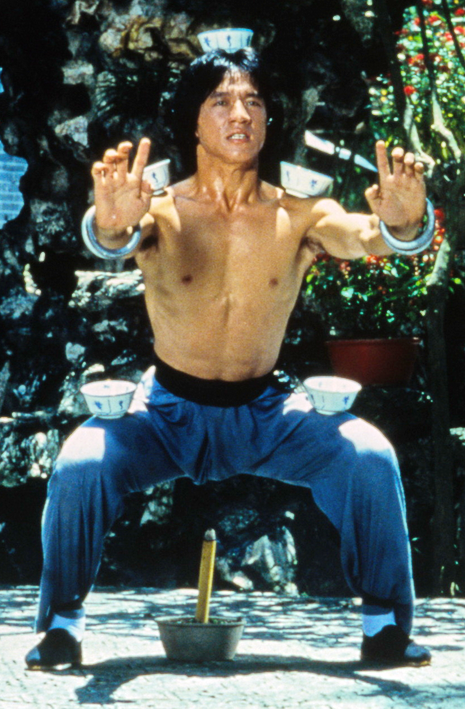
站樁 (Zhàn Zhuāng) [Standing (like a) Post] is not unique to Xingyiquan. If you saw Jackie Chan in “Drunken Master” (see pic below) you will have seen a training montage which had Jackie standing in 馬步 (Mǎ Bù) [Horse (Riding) Stance] – complete with teacups balanced on his thighs and a large moxibustion stick beneath him. The image serves as a good comedic example of hardcore stance training found in other Chinese Kung Fu styles.
The Sāntǐ Shì posture itself, is said to have been created by 李洛能 (Lǐ Luònéng) – the father of 形意拳 (Xíngyìquán). Lǐ learned 心意拳 (Xīn Yì Quán) from the 戴家 (Dài jiā) [Dài family], but the Dài family themselves do not practice Sāntǐ Shì. They do however, place considerable value on 樁法 (Zhuāng Fǎ) [Post (-standing) Methods], they just do it using other postures. If you think about the connection between Xingyiquan (inc. Xinyiquan) and spear fighting, it doesn’t take a big leap of the imagination to see where Lǐ came up with the idea.
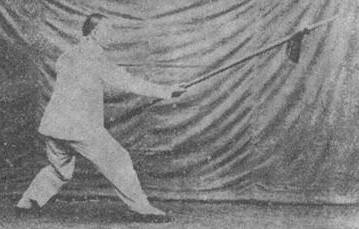
Notice how, compared to the photos of Sāntǐ Shì found elsewhere in this article, the most extended hand is lower when holding a spear. And yet when the spear is absent, the same hand is repositioned a little higher up, effectively replacing the spearhead as vanguard.
The Three Bodies
To answer the question of what are the ‘Three Bodies’ of Sāntǐ? I suggest we look to this line from Tim Cartmell’s “Xing Yi Nei Gong” (4);
“The three “bodies” (San Ti or trinity) in martial arts
refer to the head, hands and feet.”
Tim Cartmell
In this excerpt from his “A Study of Xingyiquan” (5), 孫祿堂 (Sūn Lùtáng) adds a little more, (my translation);
三體者,天地人三才之象也。 (Sāntǐ zhě, tiān dì rén sāncái zhī xiàng yě.)
The ‘Three Bodies’ are Heaven, Earth [and] Mankind: [these are the] forms of Sāncái.
在拳中為頭手足是也。 (Zài quán zhōng wéi tóu shǒu zú shì yě.)
In boxing they are the Head, Hands, and Feet.
These lines make reference to; 三才 (Sāncái) [(the) Three Talents / Abilities], so let me clarify that in Xingyiquan parlance, the name ‘Sāntǐ Shì’ is synonymous with ‘Sāncái Shì’. Sāncái Shì was used more in Xingyiquan’s earlier days, but presently Sāntǐ Shì seems to have become the more popular ‘go to’ term.
Pulling a little more on Sūn’s ‘Sāncái’ thread, we find some cosmogonic roots for the term. Take this line from chapter forty-two of Daoism’s foundation text, the 道德經 (Dàodéjīng) (my translation);
「 道生一,一生二,二生三,三生萬物。」
“The Dao generates the One, the One generates Two, Two generate Three,
[and the] Three generate the Ten Thousand Things.”
Here, we find the ‘One’ referring to 太極 (Tàijí), and despite Tàijí being composed of two differentiated parts (Yīn and Yáng), while it is still in the state of being Tàijí, they are not yet fully separated. The ‘Two’ refers to the 兩儀 (Liǎngyí) [Two Gifts], as this is the point when Yīn and Yáng are considered to have fully separated. Then comes the interaction between Yīn and Yáng to create a new, third thing: Sāncái. This ‘one to three’ idea, likely came from the 易經 (Yìjīng) [Classic of Change], which predates the Dàodéjīng, and is still a popular source of guidance for people today.
The Yìjīng says that Sāncái is a trinity composed of; 天人地 (Tiān, Rén, Dì) [Heaven, Mankind, Earth], and even today we have Xingyiquan luminaries like 邸國勇 (Dǐ Guóyǒng) making reference to that (6). In this version of the Sāncái trinity, the Heavens correspond to pure 陽 (Yáng), the Earth to pure 陰 (Yīn) and Humanity is considered the third thing, composed of those two parts. If you think about it from a symbolic point of view, when humans die our bodies decay and return to a form that bears similarity to Earth (bones obviously taking longer), and while we live, we cannot survive very long without air passing through our corporeal form (air here representing the Heavens). Our life-filled, carbon-based bodies can then be looked on as an admixture of the Earth and the Heavens.
Looking at the Sāncái trinity through a Daoist lens and seeing Heaven-Man-Earth, is only seeing half the picture – the macrocosmic side. They also have a microcosmic Sāncái which is the; 三寶 (Sānbǎo) [Three Treasures]. When itemised, these Three Treasures are; 精, 氣, 神 (Jīng, Qì, Shén) [Essence, Qì, Spirit], and despite these being more personal (relating to the self), they are no less metaphysical.
“…if the Three Bodies are successfully integrated, myriad things will grow and become prosperous.”
李文彬 (Lǐ Wénbīn)
“Shang Yun-xiang style Xingyiquan” (p.39)
Getting Specific
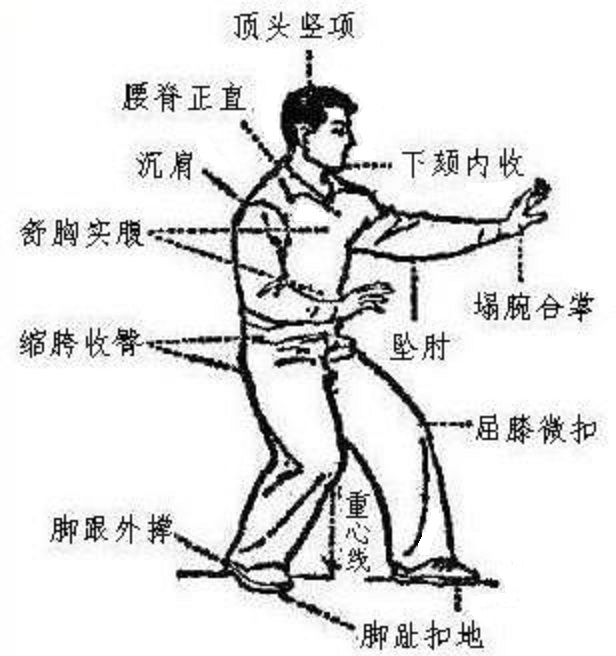
The details of this posture (how high each hand should be positioned et cetera), vary from school to school, and my intention is to not lead you one way or the other. The thing to note here is that, there is plenty of detailed guidance out there about how each school feels is the way to get the most out of this standing practice. You could also look to the classic writings of Xingyiquan – maybe start with the 《九歌》 (Jiǔ Gē) [Nine Songs] (7). A more expanded, explanatory title for this work could be; “The Nine Songs (on the Essential Points of Sāntǐ Shì)” as, the song(s) refers to nine particular parts of the body and gives the unknown Xingyi master’s prescription as to how those parts should be optimally positioned (while standing in Sāntǐ Shì).
When it comes to specific instructions on Sāntǐ Shì, it would be best to start with your own teacher’s advice. Much later on, it is worth listening to these words from Xingyiquan teacher 李奎垣 (Lǐ Kuíyuán), which he attributes to his own teacher, 郭雲深 (Guō Yúnshēn) (8);
「法術規矩在假師傳。(Fǎ shù guīju zài jiǎ shī chuán).
[“Rules, methods, [and] established standards, [can be] ‘borrowed’ from your teacher’s transmission.]
道理巧妙須自己悟會。」 (Dàoli qiǎomiào xū zìjǐ wù huì).
[Principles and ingenuity, must [be] gathered [from your] own comprehension.”]
If I may paraphrase, Mr. Guō suggests that to get Santi Shi right for you, you will need to listen to your body and work it out for yourself.
Variation in Sāntǐ Shì
In 1920, aged sixty, Sūn Lùtáng took a research trip to 山西省 (Shānxī Shěng) [Shānxī province] and visited 宋世榮 (Sòng Shìróng). Upon his return he adjusted how he stood in Sāntǐ Shì. In the Sòng family style, there are two versions of Pī Quán: a Yīn and a Yáng version, of which there are similarities to how Sūn demonstrates Sāntǐ Shì in the two photos below. Part of the reason he gave for the change was, that it “made it more conductive for development of inner power”.
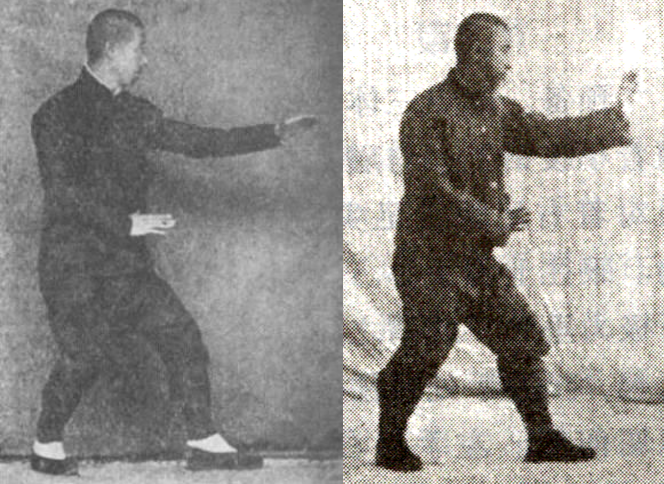
Left: his early ‘Yáng’ version; Right: his later ‘Yīn’ version.
Personally, I find it interesting how much more martially aggressive (and consequently Yáng) the earlier version is. As he grew older that side takes more of a back seat, and the ‘Yīn’ side comes into focus, showing a greater emphasis on health over fighting.
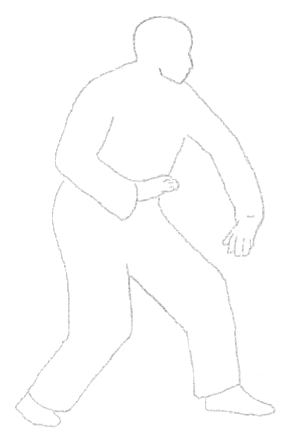
In Dan Miller & Tim Cartmell’s “Xing Yi Nei Gong: Xing Yi Health Maintenance and Internal Strength Development” 王繼武 (Wáng Jìwǔ) [a grand-student of 劉奇蘭 (Liú Qílán)] demonstrates two versions of Sāntǐ Shì. One version is the classic Sāntǐ Shì that we see everyone doing in the photos above, which is labelled as ‘Single Hand San Ti Shi’. The other version (see illustration below), is called; ‘Double Hand San Ti Shi’ – although I’ve also heard the posture called ‘Old (style) Sāntǐ Shì’ from other sources. It is common to find the ‘Single Hand’ version at the commencement of Xingyiquan forms (in various lineages), and the ‘Double Hand’ version at the end of those same forms.
In Closing
If we look on Sāntǐ Shì as a set of principles and not a posture, it can change the way we practice it. All those variations of the posture you see in the pictures above, all the contrasting advice from different schools, or those found in those classic Xingyiquan songs, should no longer present a problem. Rather, they become avenues of investigation to further explore this foundational practice. With an exercise that you could practice in a hallway, space isn’t an issue, so the only ‘problem’ left standing (pun intended!), could be finding the time to practice.
Notes
- Simplified hanzi: 三体势
- I am fully aware of the irony of using this picture of 傅劍秋 (Fù Jiànqiū), labelled as 劈拳 (Pī Quán), when the article is about Sāntǐ Shì. But ten points to Gryffindor if you spotted it!
- This is a still from; 醉拳 (Zuì Quán) [“Drunken Master”] (1978), directed by Yuen Woo-ping & distributed by Seasonal Film Corporation.
- See “Xing Yi Nei Gong: Xing Yi Health Maintenance and Internal Strength Development” by Dan Miller & Tim Cartmell, p.39 (Unique Publications).
- Specifically, you can find this in part one, section four (形意三體學 [A Study of Xingyi[’s] Sāntǐ [Shì]]) in; 《形意拳學》 [“A Study of Xingyiquan”] by 孫祿堂 (Sūn Lùtáng). You can find a free English translation online, by Paul Brennan here.
- “Di Guoyong on Xingyiquan: Volume 1 – Five Element Foundation” by Di Guoyong, translator Andrea Falk, p.10 (published by TGL books). You can get a copy direct from Andrea Falk here.
- Not to be confused with the famous 《九歌》 (Jiǔ Gē) [Nine (Poetry) Songs], attributed to 屈原 (Qū Yuán), of the Warring States period).
- You can find the quoted line in its original context in; 《拳意述真》 “The True Meaning of Boxing” by Sūn Lùtáng. Here’s a link to Paul Brennan’s English translation (which includes the Chinese characters).
- You can find much clearer photos of this concept in Tim Cartmell’s book (see note #4), which I highly recommend.


Leave a Reply
Want to join the discussion?Feel free to contribute!