
Demons (Part 1)

 Di Qing – The Warrior of Yecha by Xu Zhelong (1)
The monster is a cultural body, containing the fears, anxieties and desires of the culture in which it is born. (2)
This idea likely stems from noted psychologist Carl Jung’s theory of demons being archetypes of the collective unconscious. With this in mind, I would like to explore a particular Chinese demon called the Yecha.
Okay, I say Chinese demon, but the funny thing is, the Yecha started out on the other side of the Himalayas, as the Yaksha of India. The Chinese name 夜叉 (Yèchā) is a transliteration of the Yakṣa [Sanskrit: यक्ष ] and both are frequently transliterated into English as ‘Yaksha’. In the transliteration process the person creating the Chinese version would have chosen the most similar sounds to approximate the Sanskrit, the result uses the hanzi (Chinese characters) for ‘Night Fork’ – Yè (Night), Chā (Fork).
[The] “…yaksa and raksasa are not indigenous Chinese ghosts, but figures from Buddhism. The yaksa and raksasa are among the most important demons in Buddhist culture.” (3)
The Indian Yaksha came in two varieties; the benevolent tutelary nature spirit, and the Bhūta [Sanskrit: भूत ] variety; the later kind are “a kind of ghost that haunts the wilderness and waylays and devours travellers”.
In Hinduism there is a god-king of the Yakshas: Kubera [Sanskrit: कुबेर ] a god of wealth. Shiva himself bestowed kingship of the Yakshas onto Kubera, and Kubera was later assimulated into the Jain and Buddhist pantheons (sidenote: he’s called Vaiśravaṇa or Vessavaṇa [Sanskrit: वैश्रवण ] in Buddhism). The Yaksha are considered attendants of Vaiśravaṇa in Buddhism. Vaiśravaṇa himself being one of the 四大天王 (Sìdàtiānwáng) [Four Heavenly Kings], who are the warrior attendants that guard the Buddha.
Although the Yecha was in Hinduism first, it soon crept into Jainism and Buddhism and most likely arrived in China via stories from Buddhist migrants.

यक्ष (Yakṣa)
The Phu Yak of Thailand
As tales of the Yaksha spread abroad from India, they reached Thailand, where the Yaksha became known as the ยักษ์ [Yak], or ผู้ยักษ์ [Phu Yak] (4). These Phu Yak (both male and female versions) feature in Thai literature such as the epic poem; พระอภัยมณี (Phra Aphai Mani) [Prince Aphai (of Rattana)], and since the 14th century they have acted as guardians of Thai Buddhist temples. Over time their appearance becoming fairly standardised with green skin, protruding fangs, and large, round eyes.

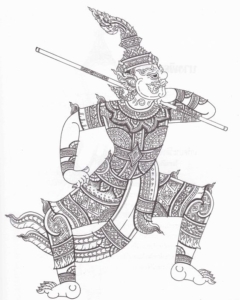
Illustration of the Yak from the Ramakien (5)
Yecha, Interrupted
Demons in culture are one thing, but sometimes they don’t transgress the personal level. In ancient times it would have been easier to express personal fears and anxieties in the form of demonic stories, and if the collective unconscious picked up on them, these demons may have gone on to have entered the culture. These days fictional horrors don’t get believed in, in quite the same way as they did centuries past. There is of course still ignorance in modern educated cultures, but the style of it has changed (dramatically so in the internet age), and it no longer expresses itself as the whole village believing in colourful characters (possibly with horns) bringing harm to the innocent [please feel free to entertain us with the exceptions in the comments box].
These days people still have demons but we have names for them; like anxiety, low self-worth, depression, and there are also a minority who still see horrors that others would never believe. For those in need there is help available. If you are struggling with things like personal fears, intense anxiety or depression, talking to professionals can help. Here’s some links to more information on helplines;
United Kingdom Mental Helpline Information
https://www.nhs.uk/conditions/stress-anxiety-depression/mental-health-helplines/
United States Mental Helpline Information
https://www.nami.org/Support-Education/NAMI-HelpLine/Top-HelpLine-Resources
https://samaritanshope.org/our-services/247-crisis-services/
Please take care of yourself,
DFA
P.S. “Interrupted?” Yes. In the next two parts of this article we will look specifically at the Yecha’s journey through Chinese literature.
Notes
- The amazing artwork of Xu Zhelong is totally worth checking out. You can find it here; https://zhelongxu.com/. My suspicion is that this artwork is named for 狄青 (Dí Qīng) (1008–57 CE).
- This quote is taken from Sarah Louise Dodd’s 2013 PhD thesis, which you can read in full here; http://etheses.whiterose.ac.uk/6445/1/Dodd_SL_ModLang_PhD_2013.pdf and you can read Jeffrey Jerome Cohen’s ‘Monster Culture’ (published in 1996) which SLD references here; https://americanhorrorstoriessite.files.wordpress.com/2017/08/jeffrey-jerome-cohen-monster-culture-seven-theses.pdf
- “Buddhism and Tales of the Supernatural in Early Medieval China: A Study of Liu Yiqing’s (403-444) Youming Lu” by Zhenjun Zhang.
- This is in the Thai RTGS (Royal Thai General System) of transcription.
- The รามเกียรติ์ (Ramakien) is Thailand’s national epic, derived from the Buddhist Dasharatha Jataka.


Leave a Reply
Want to join the discussion?Feel free to contribute!