
The Devil Can Only Travel in Straight Lines
Introduction
When I first read the titular phrase, I had to laugh. What does that even mean?! How can any creature, mythical or otherwise, only move in straight lines? Was it supposed to be a scary creature? If so, it becomes a lot less frightening once you know you can just make a small step to the side and watch it go straight past and off into the distance. If it can never turn, shouldn’t the phrase be ‘line’ (singular), not ‘lines’ (plural)? The bizarro logic of the whole thing broke my brain a little trying to work out a way it could make sense. The more I looked into it though, the more I heard the phrase attributed to Chinese origins, which only piqued my curiosity further.
Architecture
In the vague hope that the internet could provide something to help me confirm its origins, with something like a Chinese version of the phrase, I went down the rabbit hole. The first thing I came across was the suggestion that Asian roofs are curved at the corners because of it. With a little more digging, I heard out about how the roofs actually provide more direct winter sunlight into the property if curved, and the curvature changes across these far eastern countries depending on how close their latitude is to the equator. Another lead led me to the barriers found at the entrances to 四合院 (Sìhéyuàn) [Chinese courtyard residences]. These traditional courtyard houses would sometimes have had a wall either in front of, or just inside the entrance. These walls are known as: 影壁 (Yǐngbì) [Spirit Screens, lit. Shadow Walls], and 照壁 (Zhàobì) [Reflection Walls], and were said to have been put there because… ‘evil spirits can only travel in straight lines’.
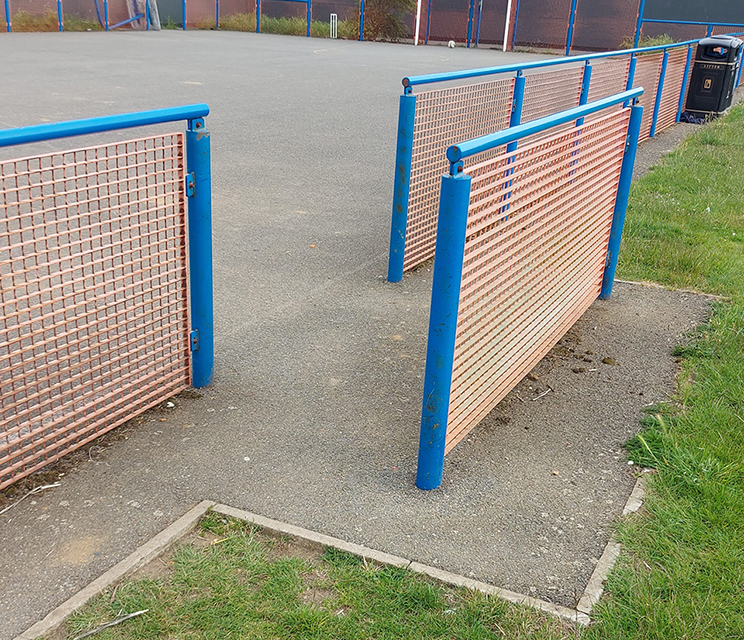
Unlike the one in the playground picture, the Chinese versions of this barrier were always solid, and the most likely reason I found, maybe more than privacy, was as wind-breakers. Forcing a strong wind to go around a corner would break its strength considerably, so the courtyards that used these barriers would effectively reduce any health issues derived from chilling winds. I would say that there is an argument for any ill health derived from direct cold winds being attributed, in ancient times, to ‘evil spirits’; strong winds can sound pretty spooky after all.
Loss of Face
Another internet source related the phrase to ‘loss of face’. ‘Telling it straight’ is frowned upon in business with Asian countries, notably Korea, Japan, and China. Not that there isn’t ever a time for it, but this is an especially tender point in the early stages of business relationships. To negatively affect someone’s social status, hurt their reputation, or humiliate them is known as making them 丟臉 (diūliǎn) / 丟面子 (diūmiànzi) [lose face]. Giving direct criticism, bad news, instructions, or anything that could cause the person to feel embarrassed, uncomfortable, or less senior are things that could make that person lose face, and should be done in private. If you make a pitch or suggestion in a meeting and your Chinese colleague says something like: “That’s very interesting and worth considering” but then immediately changes the subject, then the chances are that they were actually saying the opposite, and were trying to help you ‘save face’.
In this scenario, I guess the idea would be that only evil spirits would verbally approach directly (‘in a straight line’). In contrast, good people would ask things indirectly, in order to allow the person being asked, the opportunity to dodge the issue before it becomes awkward.
Mazes and Beliefs
Whether or not we can come up with a reasonable explanation for it, is secondary to the fact that it is definitely a superstition from ancient China, and yet China isn’t alone in its magical reasoning for avoiding straight line travel. I first read the titular phrase at the site of the Hilton turf maze, in Cambridgeshire (U.K.). The turf maze itself was originally cut in 1660 and has been maintained ever since. In general English turf mazes are unicursal, meaning they have a single path with no wrong turnings and the path coiled into a circle-shaped labyrinth. The information board at Hilton suggested that one possible reason for these turf mazes was as a mini-pilgrimage, to cast out the Devil because… ‘the Devil could only travel in straight lines’.
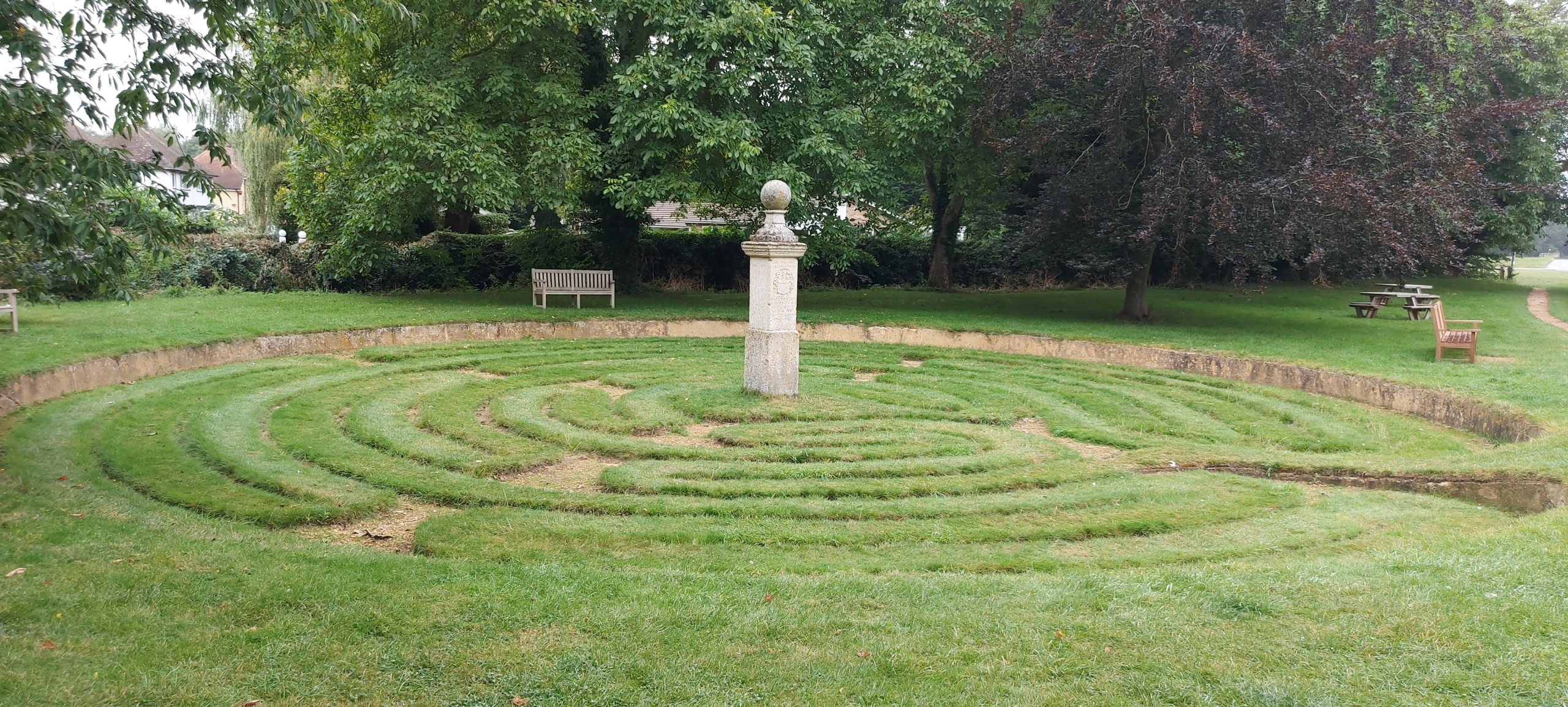
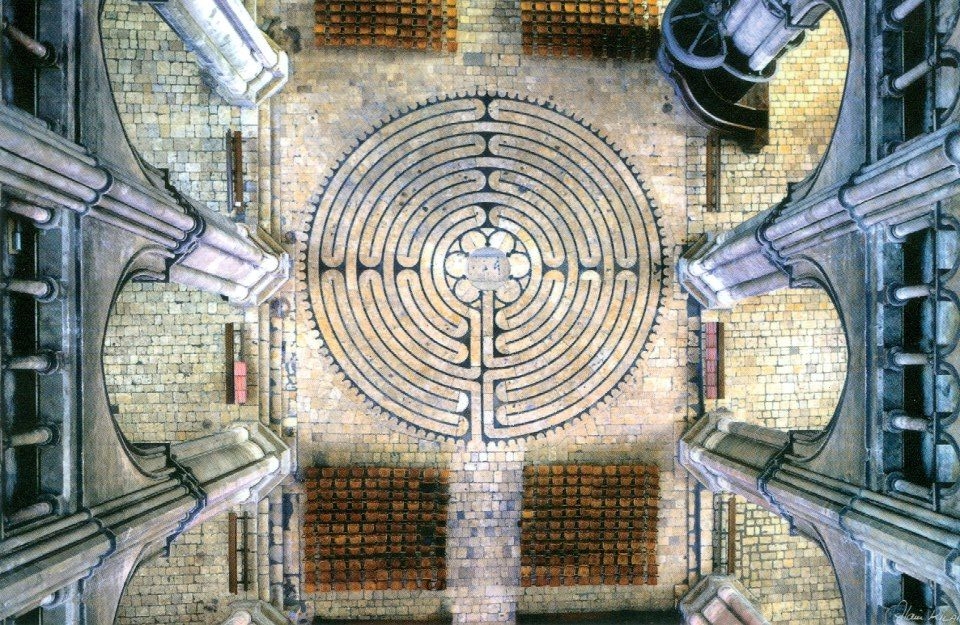
The idea of Christians walking mazes in meditation has become quite popular in the last few decades (1). Chartres cathedral near Paris, however, has had a maze floor pattern since they finished building it in 1171. So maybe the recent interest is more of a revival; prayer and mental focus do make for a classic coupling after all.
Meditative walking is one use for these labyrinths but it’s not only the Devil they have been used to frustrate. In the Scandinavian countries of northern Europe, you can find hundreds of unicursal mazes similar to the UK’s turf versions but made of stone. Found mainly on the coastlines, these mazes were said to have been used by sailors and fishermen who used them to lose the Smågubbar (Little Men), evil gremlin-like spirits that would wreck their ships or ruin their catch. In following the seamen to the centre of the maze the Smågubbar would become confused, allowing the humans the chance to flee seaward without having these havoc-wreaking spirits in tow.
Nine Palaces
The idea of walking a pre-set labyrinthine path is also found in the Chinese martial art of 八卦掌 (Bāguàzhǎng), where it is used as a training practice called 九宮 (Jiǔgōng) [Nine Palaces]. Although Bāguàzhǎng is better known for walking in circles, the Nine Palaces practice trains walking around nine posts, set into the ground at regular distances to form a three-by-three square. The act of walking around the posts itself is known as 飛九宮 (Fēi Jiǔgōng) [Nine Palace Flying], or 九宮步 (Jiǔgōng Bù) [Nine Palace Stepping], and despite its strong association with Bāguàzhǎng it can also be found in other Chinese martial arts such as 奇門拳 (Qíménquán) [Mysterious Gate Boxing].
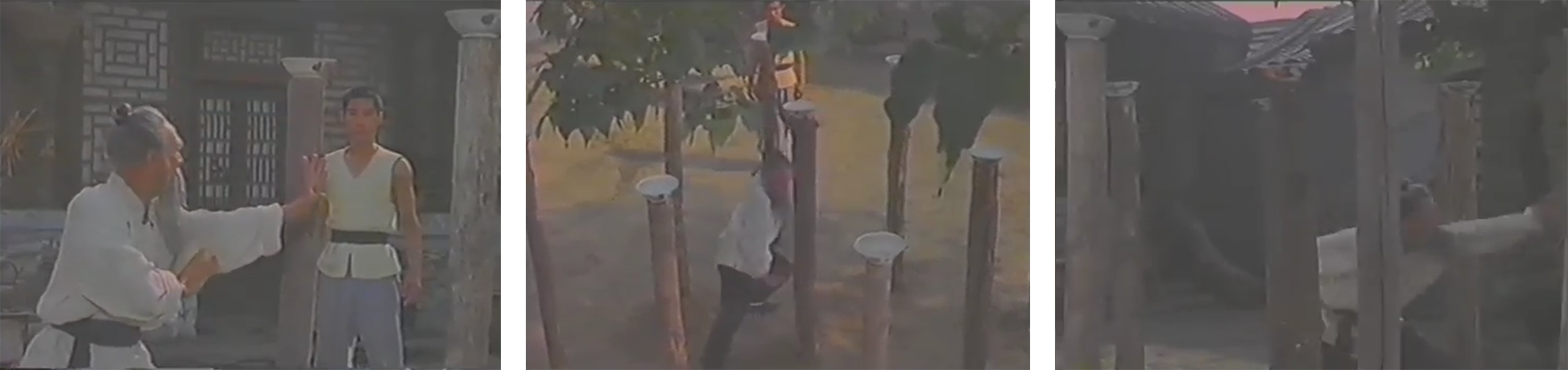
《武林志》 [English title: “Pride’s Deadly Fury / The Honor of Dongfang Xu”]
Nine Palace Flying requires focus and awareness of your surroundings as you move around the posts, training to constantly change technique and position. Ceaseless movement means never sticking to a single adversary, which helps develop a special awareness for dealing with multiple opponents. The constant switching of sides as you walk through the posts can help highlight any leaning that may have begun to develop in your circle walking, and hopefully help alleviate it. Done well, it should look a little like a mythical Chinese dragon winding through and around the posts. When you add-in striking against the posts, you can then begin to work on hitting targets from varying and unexpected angles and at weird moments – skills valued by a professional fighter.
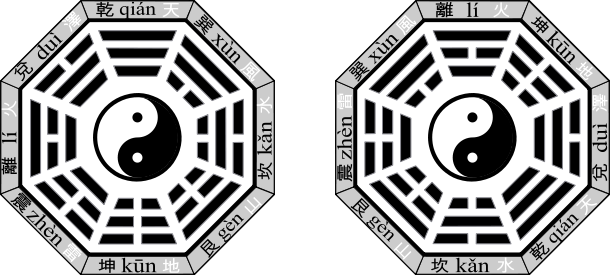
Each of the posts are considered to be one of the nine palaces (more on this later) and each is associated with one of the trigrams (a symbol of three lines) from the Bāguà diagram. I know what you’re thinking, if there are eight symbols in the Bāguà diagram and nine posts, what’s the deal with the extra one? The middle post gets the special title of: 中宮 (Zhōng Gōng) [the Central Palace]. There is another sticking point with this idea though: the Bāguà diagram has classically been set into two arrangements, the Pre-Heaven arrangement of Fúxī, and the Post-Heaven arrangement by King Wén (2). My research didn’t turn up exclusive association with one more than the other though.
The Luò River Sequence
Maybe more useful than associating the posts to Bāguà trigrams would be to establish a set path around the posts, much like the unicursal mazes. Giving each post a number, like a Sudoku grid, means we could then sequentially progress around the posts from one to nine. The Bāguà boxers have already thought of this, and have numbered the posts using 洛書 (Luòshū) [Luò (river) writings]. Depending on which way you circle around the posts (clockwise or counter-clockwise) it was then called either ‘Smooth Piercing’ or ‘Reverse Piercing’.
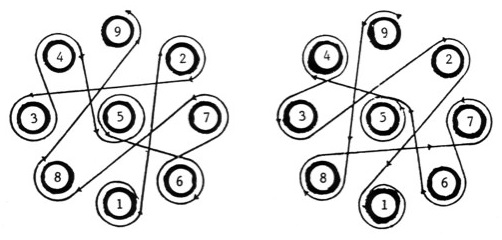
The numbering layout of the Luòshū originates in pre-history, just before the Xià dynasty (of which we have no records). There is a legend known as: 大禹治水 (Dà Yǔ Zhì Shuǐ) [Yǔ the Great controls the waters] (3), which tells of how the 黃河 (Huáng Hé) [Yellow River] was suffering with disaster-level flooding, which naturally caused a whole host of misery, including famine. A man named 鯀 (Gǔn) tried to solve the problem but died without success and then his son: 禹 (Yǔ) took over the task and organised the building of irrigation canals along the Yellow River. These provided the much-needed flooding control, giving Yǔ the success his father had so desperately sought. Yǔ became known as 大禹 (Dà Yǔ) [Yǔ the Great], or 夏禹 (Xià Yǔ) [(Emperor) Yǔ (of the) Xià] (c. 2123-2025 BCE), as the people put him on the throne after he resolved the flooding issues. This made him the first emperor of the Xià dynasty.
It is said that after the flooding abated, a mystical turtle called the 龍龜 (Lóngguī) [Dragon-Turtle] emerged on the banks of the 洛河 [Luò river] (a tributary of the Yellow river) bearing a curious pattern on its shell, circular dots grouped as if to represent the numbers one to nine. This pattern became known as the Luòshū.

The earliest textual reference of the Luòshū can be found in the pages of the 莊子 (Zhuāngzǐ) (369-285 BCE), where the Daoist philosopher mentions the 九洛之事 (Jiǔ Luò zhī shì) [‘Nine Luò’ matters] (4). Later, came religious Daoists who theorized that the Big Dipper (a constellation important to them) had nine stars instead of just the seven that we associate with it today, and that 太一 (Tàiyī) (the Daoists’ top god, considered the Emperor of the Heavens) lived in a palace in the centre of the night’s sky. The Daoists thought that they could invoke the spiritual power of this nine-star constellation by following the same pattern. Emulating Tàiyī’s path through his palace, from first star to last. This walking pattern followed the sequence of the Luòshū but they called it: 「太一行九宮之法」 (“Tàiyī xíng jiǔgōng zhī fǎ”) [Tàiyī’s Method of Walking through the Nine Palaces]. Later, they also called it 禹步 (Yǔbù) [The Steps of Yǔ] in deference to the aforementioned 夏禹 (Xià Yǔ) [Emperor Yǔ], ‘Father of Chinese culture’ (see above). In more recent times this progression has even acquired yet another name: 「戴九履一圖」 [“One picture (/ diagram) wearing nine shoes”].
The Nine Palaces of Tàiyī were not the only possible source for the moniker of this Bāguàzhǎng practice; the Confucians also had a ‘Palace of Wisdom’ with nine halls. In the 明堂位 (Míngtáng Wèi) [Position in the Palace of Wisdom] chapter of the 《禮記》 (Lǐjì) [“Record of Rites”], the author relates the Luòshū to a layout of nine halls to be found inside the palace (5).
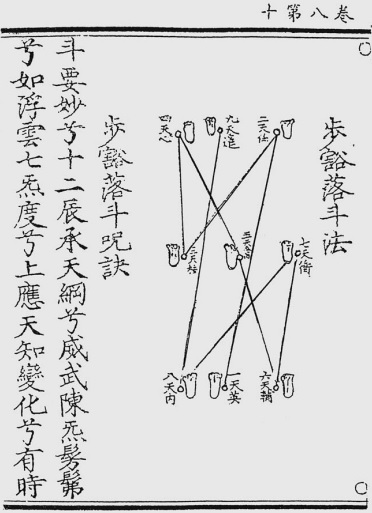
Bāguàzhǎng master 孫祿堂 (Sūn Lùtáng) complicates the whole thing even further when he describes the 九宮圖 (Jiǔgōngtú) [Nine Palace Diagram] as having the external pattern of the Luòshū but containing the internal essence of the 河圖 (Hétú) [(Yellow) River Diagram] (6):
「河圖之理藏之於內。 洛書之道形之於外也。」
[“The Hétú’s internal essence is hidden within (the Nine Palaces), the Luòshū’s external form is their path.”]
孫祿堂 (Sūn Lùtáng), 《拳意述真》 [“Relating the True Meaning of Boxing”] (1924)
The Final Step
In practice, focusing on walking a confusing pattern like labyrinths, mazes or the Nine Palaces in the Luòshū sequence, doesn’t have to be just for fun or superstition. As a meditation, walking the maze-like pattern of the Nine Palaces can frustrate, or encourage us to forget, our conscious selves (7). Minimising the influence of the mind’s logic-centre on our regular thinking is a technique used by Daoists to shift the mind towards 無為 (wúwéi) thinking, or by Chán (禪) Buddhists to step towards enlightenment. You can find this logic breakdown idea in Zhuāngzǐ’s philosophical writings and in the paradoxes of Zen Buddhism’s Kōan riddles, which were heavily influenced by him. The idea is to, in a structured way, introduce doubt into our foundational logic in order to down-regulate the prefrontal cortex (logic centre of the brain), which usually controls conscious thinking. This allows the subconscious mind, which reacts quicker, to gain a more palpable influence over our moment-to-moment thinking.
In Bāguàzhǎng we walk the Nine Palaces to improve coordination, awareness, and train against multiple opponents, but we can also use it as described above, as a meditation. Once the pattern is mastered, or the state of mind achieved, the practitioner can also simply let go of the sequence entirely and just flow through the posts along whichever path takes them. Were we to apply the titular phrase to Bāguàzhǎng’s Nine Palace practice, we could see it as externally training ourselves to constantly turn in order to oppose the ‘evil spirits’ of those that would inflict violence upon us, or internally, to lose the ‘devils’ of weak mental focus, anxiety, or depression.
And in the end, I did -eventually- find that phrase in Chinese:
「鬼只能走直线。」
[Demons can only travel in straight lines]
Notes
- See: “Walking a Sacred Path: Rediscovering the Labyrinth as a Spiritual Practice” by the Reverend Dr. Lauren Artress, Riverhead Publishers, 1995.
- 伏羲 (Fúxī), is a legendary figure, who along with his sister-wife 女媧 (Nǚwā), is credited by the Chinese with creating humanity. He is also said to be the inventor of fishing, trapping and the Chinese writing system. 周文王 (Zhōu Wén Wáng) [King Wén (of Zhōu)] (c. 1152-1056 BCE), reigned c. 1099-1056 BCE as the king of the Zhōu state. He was a leading figure in building the subsequent Western Zhōu dynasty, and father to 周武王 (King Wǔ of Zhōu) the first emperor of the Zhōu dynasty.
- It is also known as: 鮌禹治水 (Gǔn Yǔ zhì shuǐ) [Gǔn (and) Yǔ control the waters].
- The mention comes in the 外篇 (Wài piān) [Outer Chapters], Ch.14, 《天運》 [“The Movements of the Heavens”].
- The “Lǐjì” is one of the core texts of the Confucian canon. It dates from approximately 475 to 221 BCE.
- The Hétú is a different arrangement of the numbers 1-9. It still has the number five in the centre, but it has two numbers on each of the cardinal directions (like a plus sign) instead of a single number on each of the eight sides (like an octagon).
- This ‘forgetting’ is much like the concept as found in the Daoist practice of 坐忘 (Zuòwàng) [Sitting and Forgetting] seated meditation.
References
- “The Evolution of the Zhaobi: Physical Stability and the Creation of Architectural Meaning” by Li Mengbi, The Journal of Architecture, Vol. 25, Issue 1, 2020.
- “Mazes and Labyrinths” by Nigel Pennick, Robert Hale Publishers (1990).
- “Teach Yourself Chinese Myths” by Te Lin, Teach Yourself Books (2001).
- “Legacy of the Luoshu – The 4,000 Year Search for the Meaning of the Magic Square of Order Three” by Frank J. Swetz (2008), A. K. Peters Ltd. (Publishing).
- “Pa-Kua: Eight-Trigram Boxing” by Robert W. Smith & Allen Pittman, Tuttle Publishing (1990) p.47-49, 55.
- 《拳意述真》 [“Relating the True Meaning of Boxing”] (1924), by 孫祿堂 (Sūn Lùtáng), Free online English translation here.
- “Trying Not to Try: The Art and Science of Spontaneity” by Edward Slingerland, Crown Publishers (2014).
- https://www.newscientist.com/article/2151137-your-autopilot-mode-is-real-now-we-know-how-the-brain-does-it/
Picture Credits
The “Playground Reflection Wall” and “Hilton Turf Maze” pictures are both copyright Terry Neil (2022).
I couldn’t find the source for the beautiful aerial shot of the floor maze at Chartres Cathedral. I also couldn’t find the source for the other three pictures but believe the two non-turtle ones to be out of copyright. As always, if you are the copyright holder and object to the picture being used here please let me know and I will take it down.
《武林志》 (Wǔlín Zhì) [English title: “Pride’s Deadly Fury”, a.k.a. “The Honor of Dongfang Xu”] was directed by 張華勛 (Zhāng Huáxūn), produced by 北京电影制片厂 [Beijing Film Studio], and released in 1983. The film includes a training montage (see picture for stills) of 神拳李 (Shénquán Lǐ) [Spirit-fist Lǐ], played by 張雲溪 (Zhāng Yúnxī) using the Nine Palace posts to teach Bāguàzhǎng to 東方旭 (Dōngfāng Xù) [Xù from the East], played by 李俊峰 (Lǐ Jùnfēng).


Very good site you have here but I was wondering if you knew of any community forums that cover the same topics
discussed in this article? I’d really love to be a part of a group where I can get advice from other experienced individuals that share the same interest.
If you have any suggestions, please let me know.
Thanks!
Hi there,
you might like to check out this: https://rumsoakedfist.org/
It’s a forum for the kind of martial arts I talk about in these articles.
Best wishes,
Terry@DFA
Right here is the right website for anyone who wants to understand Pakua. You get it a whole lot. Its hard to argue with you (not that I really will need to… HaHa). Excellent stuff, just excellent!
Really great post. I simply stumbled upon your blog and wanted to mention that I have truly enjoyed browsing your
blog posts. After this, I’ll be subscribing to your rss feed and I hope you write again soon!
I wish there was some Bagwa here (Equatorial Guinea).
Between your wit and your pics, I was almost moved to start my own blog (well, almost…HaHa!) Great job.
I really loved what you had to say, and more than that, how you presented it.
Too cool!