
Dogs of War
When Shakespeare wrote: “Cry Havoc! And let slip the dogs of war!” he created a lasting metaphor for savage soldiers, loyal to their king. The source material he used for that play included information on actual canine war dogs found in ancient Greek and Roman battles (1). When we look at dog metaphors in both Chinese and English we find they are mostly characterised by loyalty, or low status. Chapter five of the Dàodéjīng, written around 400 BCE, gives us a slightly different one though: the 芻狗 (Chú Gǒu) [lit. Straw Dog].
「 天地不仁, 以萬物為芻狗 」
“Heaven and Earth [are] not humane, [they] use all things as straw dogs.”
道德經 (Dàodéjīng), Ch. 5
Straw dogs are a type of effigy burned in ritual sacrifice in order to not have to use real dogs. The use of substitutes seems kind of ironic to me, shouldn’t a sacrifice be about giving up something of value?! Either way, I’m happy fewer dogs got killed. In this context ‘straw dogs’ are a figurative reference to a thing discarded soon after use, which I found to confuse the question of how valuable dogs were to the people of that time. Basically, although dogs symbolised low status, they were high enough that they were substituted when it came time for ritual sacrifice.
Despite the wealth of negative metaphors and imagery relating to dogs to be found in Chinese (as there is in English too), some young Chinese people are now linguistically turning that idea around, using ‘dog’ in self-deprecating humour, or as a way to appear cooler, not dissimilar to how the term as been used in America over the last decade or so (2). Not all traditional Chinese dog references seem to be negative either. If you recently became a new dog owner in China, the custom would be for people to say to you 「狗來福!」 (Gǒu lái fú) [“[With a] dog, comes good fortune”].
Animal Companions
Could the dogs of ancient China have been saved from sacrifice because of an association with 寵物 (chǒngwù) [house pets (lit. treasured creatures)]? It’s unlikely. Although Chinese emperors and nobility were known to have kept dogs as pets, there were also some starving commoners known to have eaten them. These days, the first thing people think of in regard to dogs, is as animal companions, and in this regard there are few other animals that compare to the dog. Their constant, unyieldingly-sunny disposition makes them hard to compete with. China has a few unique looking pet dogs, below are a few pictures of their most famous ones.

西施犬 [Shih-Tzu], 沙皮狗 [Shar-Pei], 鬆獅犬 [Chow Chow], and 哈巴狗 [Pug] (3)
Not found in the above photomontage is the 京巴狗 [Pekingese (lit. Dog [of the] Capital)], also known in China as the 獅子狗 [Lion Dog]. For a time, these were the favourite pets of the upper tier of 清 [Qīng] dynasty society. In 1860, when the French & British troops destroyed the Beijing Imperial Summer palace, also known as the 圓明園 (Yuánmíng Yuán) [Garden of Perfect Brightness], a British captain called John Hart Dunne “found” a Pekingese dog said to have belonged to the Empress Dowager (or one of the ladies of the Imperial family). He took the dog back to England and gifted it to Queen Victoria, and with a twist of dark humour the Queen named it ‘Looty’, for the manner in which it was acquired.

Working dogs found in the military and police are used for a variety of specialised tasks, the main three being: sniffer dogs, guard dogs, and attack dogs. The Hong Kong police department has had a specialised 警犬隊 [Police Dog Unit] since 1949. This unit uses sniffer dogs for the search and rescue of people, and to seek out concealed drugs and explosives, as well as using attack dogs to work crowd control. Whereas the Chinese military is said to have over ten thousand dogs in its employment, with their canine of choice being the 昆明犬 (Kūnmíng quǎn) [Kūnmíng wolfdog]. Although there are many dog breeds that come from China (see above for examples), the Kūnmíng wolfdog is the only dog breed internationally recognized as having been developed there through breeding.

Beware of the Dog
The Latin sign ‘Cave Canem’ [Beware of the Dog] is said to have been originally intended to prevent small dogs from being trodden on by house guests, but for quite some time it has come to be more associated with discouraging burglars. It is easy to associate domestic dogs with companionship, but the role of the guard dog is also a very popular reason to own one. Dogs are not only associated with protecting their human owners, they are also well known for protecting territory too. The idea of the ‘guard dog’ is so prevalent in the Western mind that the familiar animal guardian statues you might have seen outside the gates to Chinatowns, Chinese restaurants, or temples, known in English as ‘Foo Dogs’, are known in Chinese as 石獅子 (Shíshīzi) [Stone Lions]. So, ironically they are big cats, not big dogs!

When we come to attack dogs, I’d like to deviate a little and look at dog / animal attacks against humans. Although guard dogs and attack dogs are trained for violence, humans fatalities from dog attacks are actually quite rare. The annual deaths from dog attacks in England number in the single digits, and the United States statistics are, proportionally speaking, the same. Death-by-dog is far rarer than murder-by-man it seems. Although there will always be a breed that tops the list, a study by the American Veterinary Medical Association concluded that, there is “no single breed that stands out as the most dangerous.” (5)
When it comes to bite attacks, dog bites in the United States number, roughly 4.5 million per year. This puts dogs at the top of the list for animal bite attacks, with human biters in second place at 0.25 million (per year, in the U.S.). We could consider the recorded number of dog bites to be lower if we factor-in the possibility of hyped-up legal claims, as not every bite will have been a vicious attack requiring a visit to the emergency room, but if we are factoring those in, we must then also consider the bites that went unreported because the person bitten didn’t want the dog euthanized as a result of the incident (6).
There is a story about the Daoist immortal 呂洞賓 (Lǚ Dòngbīn), who was well known for his kind heart. One day he chanced upon a starving dog and gave it the dumpling he was about to eat. The dog devoured the dumpling, but afterwards it bit him. This story became the basis for a saying used to describe someone who behaves badly to an extended kindness:
狗咬呂洞賓, 不識好人心
[The dog bites Lǚ Dòngbīn, [because it] can’t recognize a good heart.]
Unfortunately, there are inexcusable bites too, but whether they come from wild, stray, guard, or attack dogs, bites from dogs are still statistically the most common type of reported bite attacks. In his article on dangerous animals and the martial arts (7), Robert E. Dohrenwend PhD tells us: “An attack by an animal is extremely dangerous; it is at least as likely as an attack by another human being…”. If there are so many attacks on humans by animals, one might ask why martial arts are primarily geared towards protecting people from other humans. If we are attacked so often by animals (including dogs), wouldn’t you have thought that by now, there would be a martial art developed to protect us from them instead? This brings me to the civil emphasis of modern unarmed martial arts.
Unarmed martial arts have flourished where weapons were restricted by the authorities, such as when the 秦 [Qín] and 清 [Qīng] dynasties put an imperial 禁武令 (Jìnwǔlìng) [Order Forbidding Martial (Training)] into effect. This ruling restricted weapons in order to minimise armed rebellions, but it also doubled as a way of reducing deathly violence between the humans of densely populated areas, like cities (NOTE 7). People who lived in rural areas however, were constantly in the proximity of wild animals. They lurked in forests, roamed plains, and caused trouble at the fringes of villages. These rural folk may have developed unarmed answers to the problem of animal attacks, but it’s unlikely, as attacks from wild animals are extremely difficult to survive, even with weapons. Were it not a story from a work of fiction, Wǔ Sōng (pictured below) would have been easily torn to shreds by the tiger depicted.
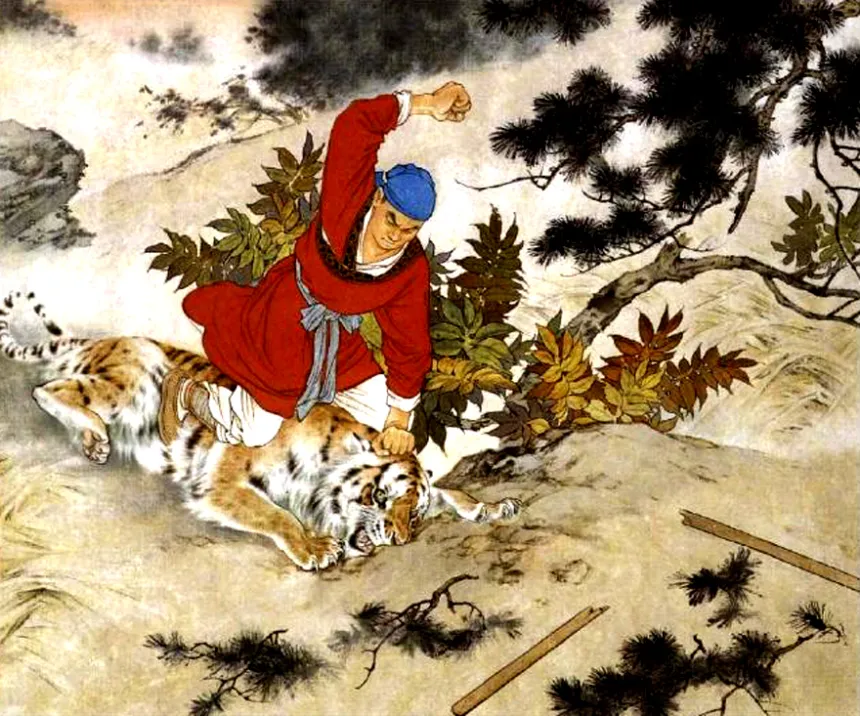
When faced with the prospect of potential contact with an animal predator, or a pack of wild dogs, it is worth considering these three points:
They are Very Likely Faster than You
Nigh-on all predators in the wild that are of a large enough size to be considered dangerous, can move a great deal quicker than you can. Over short distances, lions can move at 80 km/h, tigers 65 km/h, wolves 60 km/h, brown bears 56 km/h, Alsatian dogs 48 km/h, and the average human, a mere 10-13 km/h. When it comes to being chased, George Orwell said it best: “Four legs good, two legs bad.” (9)
They Outnumber You
When dogs return to the wild, they naturally form packs. Your best technique choice for survival against a such a pack of multiple opponents, would be to climb a tree, or shoot at them from a distance.
They are Always Armed
Wild predators are always armed. Our human hands and teeth are no equal to a wild dog’s claws and fangs. These are weapons they can never drop, and are always at the ready. Having developed the ability to use tools long ago, it is weapon-use that serves as the human’s equalizer. Maintaining distance was a key survival technique for ancient hunters. Weapons like bows or throwing spears were therefore the premier weapon choice of the human. Long weapons like spears can help keep a certain distance from a wild animal, but this would have been safer done in large groups, and even then, very, very cautiously. The Chinese have a saying: 「狗急跳牆」 (gǒu jí tiào qiáng) [“a [cornered] dog will quickly jump a wall”], and a wild dog fenced in by jabbing spears could quickly cover the spear’s distance in an attempt to retaliate or escape. So, although surrounding a wild animal is possible, it would have been nobody’s first choice.
I don’t think the limitations of their martial art occurs to most recreational martial artists. Were they to critically think about the skills they are learning, it would be a rare person that considers how defence against animals is not a part of their martial arts’ remit. Finding the circumstances under which your martial art is focused, is definitely a thought-exercise worth doing. Once you recognise the areas on which your art does focus, you can then evaluate its effectiveness when applied to the areas that lie outside of them.
Does your martial art train you to fight with your back to the floor? Does it train you to fight against more than one opponent? Against an armed opponent? I’m not saying there are good answers to any of these questions, but it is worth recognising whether your martial art tries to prepare you for these scenarios, and defence against dog attacks is typically not an area that gets covered.
Fújiàn Dog Boxing
When it comes to dogs and martial arts, there is actually a style of wǔshù (/ kung fu) called: 狗拳 (Gǒuquán) [Dog Boxing]. Despite the name, Dog Boxing is not named that because it trains you to fight against dogs, rather it is a style that imitates aspects of dog behaviour and applies them to fighting other humans. You can see these dog-like aspects in how its practitioners can fight from a position lower than their standing opponents, but you could also see it in the techniques used to bring their standing opponents to the ground through use of their own bodyweight, just like a dog would.
The concept of continuing a fight on the ground is generally considered abhorrent to the traditional Chinese martial mind-set. This viewpoint developed from fighting on battlefields where, if you fell during the battle, it would only have taken one swift stab to end you. This made getting back on your feet a life-or-death priority! It should then come as no surprise to find out that of the many Chinese martial arts that have been around since the days of such warfare, very few incorporate techniques for fighting on the ground. Dog Boxing is an unusual exception in that respect.
Recently, Dog Boxing has shifted away from its canine moniker, and transitioned to one that greater emphasizes the ground fighting aspect: 地術拳 (Dìshùquán) [Ground Techniques Boxing]. It was under this name that the art was approved by the 國務院 [Chinese State Council] to be included in the 國家級非物質文化遺產名錄 [National Intangible Cultural Heritage Directory] (10). Despite this name change making them seem like the only ground fighters of wǔshù; they don’t really linger on the floor much longer than other kung fu styles like 醉拳 [Drunken Boxing], or 猴拳 [Monkey Boxing]. None of these arts train to stay on their backs, but they all include techniques like tumbling, rolls, and break-falls. When it comes to tumbling, Dog Boxing has a saying:
「狗法落地風車輪」
[“The dog method falls, [in] a wheel [-like] manner”].
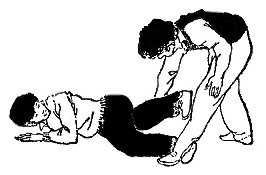
After watching a number of clips of people doing solo Dog Boxing practice, I found it appeared a lot like Fújiàn 白鶴拳 [White Crane Boxing], mixed with the tumbling and break-falls of Drunken Boxing. Once you add in a bit of dog imitation, its solo practice can make it look like one crazy looking martial art!
Origin Story
Dog Boxing’s origin story is quite a classic example of the genre, especially of the martial arts from Southern China. The mysterious Southern Shaolin temple serves as the source for the art’s martial wisdom and skills, as it does for a large number of other Southern styles. Then, we have the female founder trope as found in the origin stories of 詠春拳 [Wing Chun] and Fújiàn White Crane, and finally we have another classic trope of a hero fleeing oppression only to later repay their saviour(s) by teaching them their martial art.
福建 (Fújiàn) province is found on the south-eastern coast of China, just across the water from Taiwan, and it was here that the legendary Southern Shaolin temple was said to have been located, although our story begins a stone’s throw away at the associated 白蓮庵 [White Lotus Nunnery]. Dog Boxing was practised by the White Lotus nuns, but not the Shaolin monks, and the typical explanation as to why, is usually one of these two:
- The nuns weren’t physically able to overpower men, but fighting with this unusual method proved an effective equalizer.
- Some of the nuns had had their feet bound since childhood, and would have found fighting on their feet extremely painful / difficult.
Personally, I don’t find the feet binding thing to be all that believable. If you have ever tried any kind of ground fighting, you’d know that you need your feet too. If they are hurting or damaged, it would make it just as difficult to fight on the ground as it would standing, and as I mentioned above, dog boxers do not look to stay on their backs. There is also a fair amount of kicks and tripping techniques to be found in Dìshùquán, which I can’t see being particularly easy to do with formerly bound feet.
The Southern Shaolin temple and nearby nunnery were said to have been burned down by imperial Qīng dynasty forces after their monks and nuns participated in a rebellion. This story is so well known that it is often taken as fact, despite there being no verified physical remains of the temple or nearby nunnery found in the Fújiàn region, including under the Fújiàn temples that claim to have been built on top of it. I used to subscribe to a theory that the ‘temple’ was a reference to a Shaolin presence in the region, rather than a physical building. The ‘burning down the temple’ is then read as a reference to the act of driving the Buddhist fighting monks and nuns out of the region. But the most convincing explanation for the destruction of the monastery story that I could find, lay with the rebellious secret societies of the Southeast region. These societies later went on to become the Triads, the Chinese version of the Mafia, and hid their origins in this, more legitimate cloak. Later on, some of the martial artists in the region also used the Shaolin temple tale to lend a kind of ‘we haven’t just recently made this up’ respectability to the origins of their arts.
Only the most skilled of the monks and nuns were said to have escaped the ‘fire’, and out of those who escaped the nunnery, there was a Buddhist Nun called Sister 四月 (Sìyuè) [April] (1762-1850). Sister April managed to find refuge in Fújiàn’s 永春縣 [Yǒngchūn County], in the home of a Chén family, and in order to show her gratitude she taught Dog Boxing to the family’s son, 陳彪 (Chén Biāo) (1810-1902). In storytelling terms, Sister April could be considered a 奇人 (Qírén) [extraordinary / unusual person]. Qírén are always considered to have very high-level skills, and to live outside of everyday society. This idea easily lends itself to mysterious religious figures, like monks and nuns.

The Chén family secretly passed down this new fighting art within their family, which was a typical practice throughout China’s history (see “Say Uncle” article here). The next generation of this family saw 陳阿銀 (Chén Āyín) (1858-1942) getting into trouble after defending someone, and the villain dying soon after. Chén Āyín then felt strongly compelled to leave Fújiàn province, and fled to Singapore, where, history having a funny way of repeating itself, he found refuge in the home of another (unrelated) Chén family who were also originally from Fújiàn province. In gratitude, Chén Āyín taught Dog Boxing to the sons of his saviours, one of which was 陳依久 (Chén Yījiǔ) (1903-97).
Chén Yījiǔ had a great enthusiasm for martial arts and had already studied: 醉拳 [Drunken Boxing], 龍猴拳 [Dragon and Monkey Boxing], and 泰拳 [Thai Boxing a.k.a. Muay Thai]. After learning his new art, Chén Yījiǔ fought and beat a Russian fighter in a contest, and won great renown throughout Singapore. He then travelled to Fújiàn province, where he was originally from, and became a famous martial arts master in 福州 (Fúzhōu), the province’s capital. Eventually he achieved recognition as an outstanding martial arts master by the government. Before leaving Singapore, he became the 會長 [president] of the 新加坡武術協會 [Singapore Wǔshù Association], and after spending a fair amount of time back in Fúzhōu, he served as an advisor to their very first wǔshù organisation: the 福州鼓山武術學會 [Fúzhōu Gǔshān Wǔshù Association] (12).
Comparisons
Chén Yījiǔ’s spent many years teaching Dog Boxing in Fúzhōu, but he also maintained a degree of secrecy when teaching, this lead to the art not really spreading that far beyond Fújiàn province. The style’s animal imitative movements can also be off-putting to potential students. These techniques undoubtedly have a practical use, but to the uneducated eye it can be difficult to understand how these dog-imitation movements could be effective for fighting. One particular kick, for example, is performed like a dog lifting its leg to urinate on a tree!
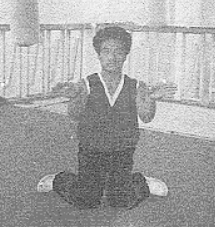
雙蝙蝠步 [Double Bat Stance] posture (13)
Dog Boxing is one of the very few martial arts in Chinese Wǔshù claiming to provide ground fighting skills to a fighter that has slipped, been thrown, tripped, or knocked down. Once modern western ears hear about a traditional Chinese ground fighting system that is said to have existed centuries before Brazilian Jiu-jitsu (BJJ) had grown out of Jigorō Kanō’s Jiu-jitsu (Judo), it becomes quite common to hear curious questions as to how well fighters from the two systems would fare in a match pitted against one another. BJJ is currently the world’s most popular ground fighting system, even China’s only ever title holder in the UFC mixed martial arts competition, 张伟丽 (Zhāng Wěilì), has a purple belt in it. The answer to any style comparison question is always the same though: it is the fighters, and not the styles that get tested.
Dog Boxing training is said to be discouragingly hard on the body, and when you combine that with the traditional secrecy surrounding teaching it, and movements that can look inapplicable, you can see why today, it is something of a martial arts curiosity, even within China.
Notes
- Shakespeare Quote The Shakespeare quote is taken from his play “Julius Caesar”, and the line is spoken my Marc Anthony in the first scene of the third act. Shakespeare’s source material for this play was “The Life of Marcus Brutus”, which was one part of a work called “Βίοι Παράλληλοι” (“Parallel Lives”) by the Greek historian Πλούταρχος (Plutarch). It was this work by Plutarch that included the concept of dogs being used in war that inspired Shakespeare.
- Dawg slang: Source: What do dog-related phrases say about Chinese culture? – CGTN
- Picture Credits. The collage picture of the four dogs, the painting of Looty, and the Kūnmíng Wolf Dog were all either Wikimedia Commons or out of copyright.
- The Foo Dog photo is copyright Terry Neil (2023).
- Fatal Dog Attack Statistics:
- Sources for Bite Statistics:
- JoAMA Article: “Dangerous Animals and the Asian Martial Arts” by Robert E. Dohrenwend Ph.D., p.8-29 “Journal of Asian Martial Arts”, Vol.19, No.1, Via Media Publishing (2010).
- Wǔ Sōng Picture: This is the work of artist 劉繼卣 (Liú Jìyǒu) (1918 – 1983), which appeared in a book he also authored, called 《武松打虎》 [“Wǔ Sōng Beats the Tiger”]. The tale of 武松 (Wǔ Sōng) beating a wild tiger to death with his bare hands comes from the 《水滸傳》 (Shuǐhǔ Zhuàn) “Water Margin / Outlaws of the Marsh”, one of the most famous novels of China. Just prior to the tiger fight, the story has Wǔ Sōng’s pride lead him into a position where he has no other choice but to fight the tiger to escape. Also note: he is unarmed because his staff broke at the beginning of the fight. Wǔ Sōng’s posture in the picture predates the illustration above, and is the source for the name of the Tàijíquán technique: 打虎 (Dǎ Hǔ) [Strike the Tiger].
- George Orwell Quote: In case you find yourself scratching your head and saying “that sounds familiar, but where is it from?” you can find this quote in chapter 3 of “Animal Farm” by George Orwell. It is a condensed rephrasing by Snowball of something Major said.
- The National Intangible Cultural Heritage Directory included Dìshùquán on the 23rd of May 2011.
- ‘Golden Scissors Intersect’ & ‘Wind Wheel’ Illustrations, Picture Credit: Although I tried to find an earlier source for these pictures, my research came back fruitless. I’m not sure where David Ross found them, but you can find his article which contains them here. You can also read more of David Ross’ articles by following that link. I really enjoy Mr. Ross’s no-nonsense writing style and have also enjoyed his Chinese Martial Arts History book “Chinese Martial Arts: A Historical Outline”, which you can buy here.
- Dìshùquán origins source link here (in Chinese).
- Double bat stance picture credit
- “Fukien Ground Fighting, and Nan Shaolin Leg Techniques: The Art and Practice of Ancient Chinese Shaolin ‘Dog-Style’ Boxing”. Original Chinese title: 《福建地術拳》 by 蔡楚賢 (Cài Chǔxián), Sugawara Martial Arts / Japan Publications (2017). You can get hold of a copy here. Side note: Using the Wade-Giles system of Romanisation, ‘Fújiàn’ was transliterated as ‘Fukien’.

Very interesting article bringing together many different threads about dogs in Chinese culture and making the link to martial arts.
Thanks for posting this. I’ve been looking for more information about Dog style Kung Fu for a while.
I read this to my puppie, we loved this. Kungfu is awesome.
I love Dog Boxing! Thanks for this.