
A Walk in the Woods
Introduction
Trees have branched into many different aspects of Chinese art, culture, martial arts and the wonderland of Daoist thought and imagery. Yet despite this, on paper, the Chinese don’t seem to care much for them. With the global environment in the state it’s in, I feel now would be a great time for us all to appreciate a little of what trees bring to this amazing world we live in.
Imagery
In Chinese art, the 松 (Sōng) [pine], 竹 (Zhú) [bamboo], and 梅 (Méi) [plum], are thought of as the 歲寒三友 (Suìhán sānyǒu) [Three Friends of Winter]. These three all share a natural ability to withstand and even flourish in harsh environments, which lead to them becoming symbols of inspiration to persevere through adversity, providing consolation in darker times. Some Daoist thinkers were particularly taken with the pine tree, for -along with its ability to survive and endure- it also became a symbol for its ability to bend. This ability to avoid going to one extreme or the other, lead to the pine becoming a personification of being neither too Yin nor too Yang (1).
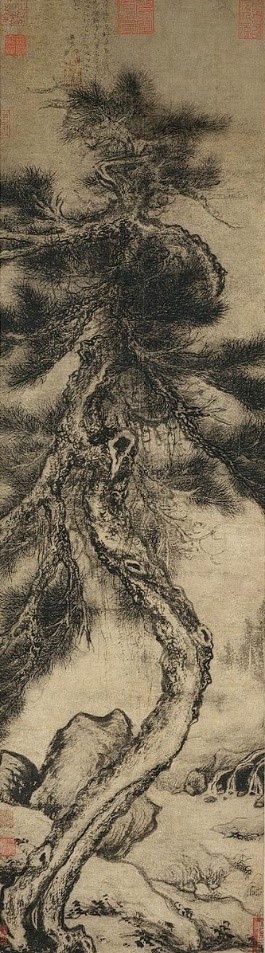
Above is a 圖軸 (Túzhóu) [scroll painting] by 吳伯理 (Wú Bólǐ) called 流水松風 (Liú Shuǐ, Sōng Fēng) [Flowing Water, Pine Wind]. Wu Boli was a Daoist priest who lived during the late 元 (Yuán) and early 明 (Míng) dynasties (approximately 1400 CE). It was painted for the Celestial Master 張宇初 (Zhāng Yǔchū), who was (at that time) the Daoist ‘Pope’ of the 正一道 (Zhèngyīdào) [Way of Orthodox Unity] group. The painting depicts an ancient pine tree, which would also have been known as a ‘Dragon Pine’ (2). The painting is also reminicent of a description by hermit painter 荊浩 (Jīng Hào) [c. 855-915 CE] in his 《筆法記》 [Record of Brush Methods] (here’s my translation) (3);
我急忙走進去, 又見那裡長滿了古松。
I walked in hastily, and saw a place overgrown with ancient pine.
其中有很粗大的樹幹, 樹皮蒼老,酷似魚鱗,
Among these was a [pine tree with a] very thick trunk, [and] old tree bark, resembling fish scales,
長著深綠色的苔蘚, 抬頭望去,
long clothed [in] dark green moss, [it] raises [its] head, hoping to go;
似騰空飛翔的蛟龍。
Appearing as if soaring and circling in the air [like the (mythic)] Jiāolóng (an alligator-like, scaly dragon).
那盤旋而上的氣勢, 好象要衝嚮九天銀河。
Many energetic, upward spirals, like [it] wanted to charge into the highest of the heavens in the Milky Way.
“For Jing Hao, as for later artists, the pine signified “the moral character of the virtuous man.” Here, the tree may also represent the Daoist sage, or “perfected being.” According to Daoist geomantic beliefs, vital energies collect at the base of a mountain slope along the edge of a stream-precisely the location of the pine in Wu Boli’s painting.”
Metropolitan Museum of Art, New York
Internal Martial Arts
The tree, as used in the imagery of the Internal Martial Arts, appears in the standing meditation found in Taijiquan (“Standing like a tree”) but only in the English. The Chinese names are more often: 站桩 (Zhàn Zhuāng) [Standing (like a) Post], 浑圆 (Húnyuán) [Perfectly Round], or 撑抱 (Chēng Bào) [Maintaining Embrace], none of which mention trees.
木 (Mù) [Wood / Tree] is the symbol for one of the five foundational fists used in Xingyiquan:
崩拳 (Bēng Quán) [Rupturing Fist]. 五行 (Wǔxíng) [Five Phases] theory, can be dated back to (at least) its inclusion into the 陰陽家 (Yīnyángjiā) [Yin Yang School of Thought] (4), but it is now also found in Xingyiquan theory. Here’s a clip (see clip below) of celebrated Xingyiquan teacher 梁克權 (Liáng Kèquán) demonstrating his internal power, by issuing force into the tree’s trunk with his body, to shake the leaf canopy.
It might be best if we leave this idea to Liang Kequan, as there are ever dwindling numbers of trees left as it is, and I don’t want letters from park rangers about how you are damaging theirs, or from your doctors telling me how you’ve damaged yourselves!
Baguazhang’s connection takes a different twist (how very Bagua!), in that its practitioners are frequently found practicing their art walking circles around trees. Why are they drawn to trees? I’ve not heard of any ‘official’ reason, but a couple of suggestions I offer are; taking advantage of the fresh oxygen the trees exude (which you could describe in Qi terms) or maybe, being able to remain fairly dry under the tree’s canopy while still being able to practice in the rain.

Tree Spirits
The usefulness of trees in Chinese culture can at times be a little heartlessly functional. This is poignantly illustrated in a classic Chinese tale about tree spirits. Despite many other cultures appreciation of mythical tree spirits, such as the Greek dryads (Δρυάδες) and other nymphs (Νύμφη), or the Japanese Kodama (木霊 / 木魂 [Wood Spirit], or 木魅 [Wood Demon]), the Chinese regard for them seems to only go so far as killing and eating them!
The Chinese Eastern Jin dynasty left us with a tale of a tree spirit called the 彭侯 (Pénghóu). The Penghou features in one of the 464 stories in the 搜神記 (Sōushén Jì) [‘Record of Searching for the Supernatural’] (written c. 350 CE by 干寶 (Gān Bǎo), a Chinese historian). Gan Bao tells us about 陸敬叔 (Lù Jìngshū) who, before he was a lord in the Eastern Wu state (one of the three major states in the Three Kingdoms period: 220-280 CE), was the governor of the county of 建安 (Jiàn’ān). Lu sent one of his men to cut down a huge 樟樹 (Zhāngshù) [camphor tree] and within a few strokes of the axe, the trunk was leaking blood. Once the tree was completely felled the men saw a creature within, with the body of a dog and the face of a man. Lu then said; “This is what’s known as the Penghou”, and with that, he gave orders to have it cooked as food.
The Penghou are said to be 樹木妖精 (Shùmù Yāojing) [Evil Tree Spirits] that only live in trees that have been growing for more than a thousand years (5). The 白澤圖 (Baízé tú) [Diagrams of the White Marsh] (written c. 3rd century) adds that the Penghou is “a creature that has evolved from the essence of wood”, and “looks like a black dog without a tail”.
Zhuangzi & Usefulness
The Daoist philosopher 莊子 (Zhuāngzǐ) [369-286 BCE], could be considered the patriarch of the self-realisation practice of 逍遙遊 (Xiāoyáo Yóu) [Carefree Wandering], but rather than go into that I’d like to draw your attention to the very end of the first of his Inner Chapters, which highlights this disregard people can have for our floral friends, when he speaks of a misshapen tree. Although the tree serves Zhuāngzǐ as a metaphor in a discussion about functionality, his response has merit at a literal level too. Here’s an abbreviated paraphrasing of Zhuāngzǐ’s misshapen tree conversation;
惠子 (Huìzǐ) (6) said to Zhuāngzǐ, “This old tree is so crooked and misshapen that it is useless for lumber. In this same way, your teachings have no practical use.”
Zhuāngzǐ replied, “This tree may be useless as lumber, but you could rest carefree in the shade it provides and know that no one will put an axe to it.”
莊子 (Zhuāngzǐ)
When it comes to lumber and Chinese forestry, the last two millennia of Imperial Chinese history has lost the country 290 million hectares of forest (Marks 2006). Then, after the fall of the Qing dynasty, during the Cultural Revolution’s ‘decade of darkness’ (1966-76) we saw Chairman Mao’s people clear 24% of China’s total forested area (Smil 1984) (7).
Zhuāngzǐ’s point about usefulness gives a new perspective to Huìzǐ: can a thing not be useful to us in more than one way? This means we have to try appreciating things for what they are, instead of trying to turn them into something else (something we already see the value of). Obviously this has a broad philosophical application to life, not simply just to trees.
Humans have always found trees useful as sources of food though, fruit trees are an obvious example. The Daoists of ancient times used Pine Sap as an ingredient in their immortality concoctions (8). By coincidence the ancient Greeks used to use pine sap to help extend the life of Retsina (a Greek wine), and once they developed a way to preserve it without the sap, they chose to keep it in for the flavour it adds. In Chinese, the word for pine nuts is; 松仁 (Sōngrén), literally this translates as ‘kindness of the pine tree’.
Forest Bathing
Art, culture and consumables are fine but it is the importance to our embodied minds that Nature has, that is far greater than we seem to currently appreciate. De-stressing with a walk in the woods has a grown a wealth of research since the Japanese came up with the term 森林浴 (Shinrin–yoku) [Forest Bathing] in the early eighties (9). Henry David Thoreau gave us a precursor to this idea when he spoke of the effect that being surrounded by nature can have on melancholy, in his Transcendental classic “Walden” (10);
“Yet I experienced sometimes that the most sweet and tender, the most innocent and encouraging society may be found in any natural object, even for the poor misanthrope (11) and most melancholy man. There can be no very black melancholy to him who lives in the midst of nature and has his senses still.”
Henry David Thoreau, “Walden”
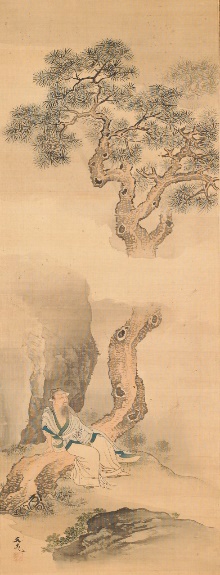
Chinese poet 陶淵明 (Táo Yuānmíng) [c. 365-427] (see picture above) (12) was the foremost poet of the 田園詩 (Tiányuán shī) [Fields and Gardens poetry] movement. In his poem; 《歸園田居》(Guī yuán tián jū) [“Returning to live in the countryside”] he concurs with Thoreau’s sentiment about the restorative powers of being surrounded by nature. He begins by talking about having been a young child who loved growing up in the countryside, before he mentions how he moved away to a ‘network of dust’ [the city] for thirty years. The poem closes with this line [my translation];
久在樊籠裡,復得返自然。(Jiǔ zài fánlóng lǐ, fù dé fǎn zìrán).
“Existing too long in a cage; restoration, [is] gained [through a] return to nature.”
陶淵明 (Táo Yuānmíng)
This is a feeling I can fully appreciate when I (get the chance to) Forest Bathe, despite growing up as a city-kid.
In Closing
A walk in the woods reminds our embodied minds that we are -deep down inside- primal beings with eons of less familiarity with glowing screens than with roaming around squelching mud between our toes and ducking our heads under branches.
Notes & References
1. In chapter seventy-six of the Daodejing, Laozi uses the metaphor of trees to describe how we should aspire to the suppleness of their early growth rather than the brittle dryness of their end.
2. Picture reference: https://www.metmuseum.org/art/collection/search/45659
3. Source for a simplified version of the hanzi for “Jing Hao’s Record of Brush Methods”; https://www.360kuai.com/pc/96a742994b1c19d7a?cota=4&kuai_so=1&tj_url=so_rec&sign=360_7bc3b157
4. The Yin Yang school was one of the 諸子百家 (Zhūzǐ bǎijiā) [Hundred Schools of Thought] that existed in the Warring States period [475-221 BCE]. It is also known as the Naturalist School of Thought.
5. Source: https://zh.wikipedia.org/wiki/彭侯 (The Penghou page on Chinese Wiki)
6. 惠子 (Huìzi) a.k.a. 惠施 (Huì Shī)) was a friendly rival philosopher to Zhuangzi from the same era. Haizi is considered to be from the 名家 (Míngjiā) [School of Logicians] rather than the Daoist school of thought. He was said to argue against Daoism in a light-hearted, humourous manner.
7. For more information on this, here’s my source; Forestry Under Mao: 1949 to 1978 – Before They Vanish (ubc.ca)
8. [Pine Sap & the Daoists]
Sources: “The Taoist Experience – An Anthology” (L. Kohn – Editor) p.150
“Daoist Body Cultivation” (L. Kohn – Editor) p. 97 Pine fruit for immortality, p. 108 White pine sap, p. 109 Pine tree sap
顏氏家訓 (Yánshì jiāxùn) [Family instructions of the Yan clan], Ch.15 “養生 (Yǎngshēng) [Maintaining good health]”
“Drug Taking and Immortality” by Akira Akahori, in “Taoist Meditation and Longevity Techniques” (L. Kohn – Editor) p.76, 78, 90.
9. Here’s a link to some Forest Bathing studies; https://environhealthprevmed.biomedcentral.com/articles/10.1007/s12199-009-0086-9
10. “Walden; or, Life in the Woods”, by Henry David Thoreau (1854).
11. A misanthrope is a person who dislikes humankind and shuns human society.
12. Picture reference: https://www.artsbma.org/collection/tao-yuanming-sitting-on-a-pine-tree/
The picture is a silk hanging-scroll called “Tao Yuanming sitting on a Pine Tree” (c. 1820 CE) by 谷文晁 (Tani Bunchō) [1763-1840], a Japanese painter from the Edo Period (1615-1868).


GAIA IS QUEEN!!! I liked all the detail you found. It’s clear that you have done a ton of research, whilst other folks just ponder on issues that they just don’t know about people could take their cue from you. Will be back to read more.
Thank you
The phrasing in this is real nice. My younger sister is always analysing such things. I will pass the link on to her.