
Demons (Part 2)
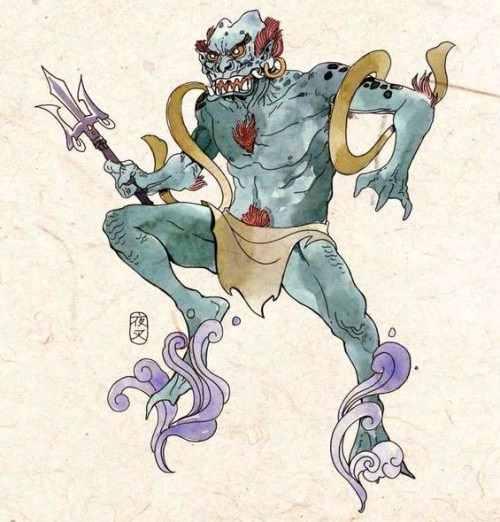
In part one we heard about the Yecha’s origins and how it travelled around India via Hinduism, Jainism and Buddhism, eventually migrating to China, likely through Buddhist travellers. Continuing on from there, I would like to share with you a peek into a few of the places that the Yecha has reared its head in Chinese literature.
“The Yecha was probably the first Buddhist demon to appear in Chinese literature.” (2)
A Collection of Lost Records
The first appearance of the Yecha in Chinese literature was so slight that it could easily go unnoticed. In a mythological / historical treatise called; 《拾遺記》(Shíyí Jì) [“A Collection of Lost Records”], compiled by 王嘉 (Wáng Jiā) – a Daoist scholar who died in 390 CE, the Yecha actually only gets one, single mention in the whole book (in the first chapter). I humbly present an attempt at a translation of it here, to give you an idea of what it said;
丹丘之地,有夜叉駒跋之鬼,
In the land of the red hill, there are demons named Yecha
能以赤馬腦為瓶盂及樂器,
[that] are able to use red agate (3) [in such a way as it can] serve as bottles, basins and musical instruments;
皆精妙輕麗。
each and every item is exquisite, simple and beautiful.
中國人有用者,則魑魅不能逢之。
The Chinese people find them useful, [as] then the 魑魅 (Chīmèi) cannot chance upon them.
一說云馬腦者,言是惡鬼之血凝成此物。
Some say that the agates, [are] the coagulated blood of the evil demons, transformed into these things.
I should mention here (rather than sticking it in the notes section), that the Chīmèi (4) are mountain demons with a tiger-like appearance. Their demonic distinction from tigers is that they lead people further into the mountains and get them lost with their power to imitate human speech (in reality, more likely echoes off the valley terrain).
In part one, we saw how the Yecha were seen as either protectors, or creatures that steal away and kill wayward travellers. I read the passage above to mean the Yecha created objects that also happened to serve as protection talismans, and the effectiveness of these talismans came from the essence (blood) of these fierce protector demons contained within them. It also struck me as slightly ironic that the talismans provide protection against other creatures who are not just killers, but specifically killers of travellers.
The Water Margin
Moving swiftly on -roughly a thousand years- to the fourteenth century, we meet a new Yecha in a beloved classic of Chinese fiction (5) called 《水滸傳》 (Shuǐhǔ Zhuàn) [“The Water Margin”, or “Outlaws of the Marsh”, but more literally: “Historical Narrative of the Water’s Edge”]. The connection between these translations of the title are indicated by ‘Water’s Edge’ (Shuǐhǔ) being an allusion to the 江湖 (Jiānghú) [Rivers and Lakes]. Jiānghú may literally translate to ‘Rivers and Lakes’ (6), but it is also a common Chinese idiom, which means: ‘Outlaws’ (7).
Among the the famously multitudinous cast of characters in “The Water Margin” we meet; 孫二娘 (Sūn Èrniáng) [lit. Second Sister Sūn] who is better known by her nickname: 母夜叉 (Mǔyèchā). Mǔyèchā can translate as a witch, shrew or vixen, but taken more literally it is; ‘Mother / Female Yecha’. She is described in the novel as having been trained in martial arts by her father, but she also has a fierce appearance, and strong limbs (“that look like clubs”), both characteristics we will later see again (in part three) associated with another Mǔyèchā.
In the novel, Sūn Èrniáng runs an inn with her husband where she knocks out visiting travellers with drugged wine, then takes their valuables and butchers them for their flesh in order to create filling for buns. Kind of like a Chinese Sweeney Todd, only preceding him by around four hundred years.

I think I’ll stick with the salad!
Once the bun-filling aspect had been established, her character later develops further, as she and her husband get involved in the fighting alongside the heroes (/ outlaws) against invaders attacking their local territory. It is with this that we get to see her as protector (of the local people) and not just a culinary traveller-predator.
Investiture of the Gods
Swimming a little further on, we come to the 《封神演義》 (Fēngshén Yǎnyì) [“Investiture of the Gods”] a.k.a. 《封神榜》 (Fēngshén Bǎng) [“Announcement of the Gods”] which was first published sometime between 1567 and 1619 CE, with authorship attributed to 許仲琳 (Xǔ Zhònglín). The book is a frame narrative, similar to the middle eastern classic “One Thousand and One Nights” (a.k.a. “The Arabian Nights”), in that it is a collection of short stories with a tenuous thread connecting them. One of the most famous stories from the collection dwarfs the fame of the book itself; that is the legend of 哪吒 (Nézhà). Side note: Nézhà’s tale begins in chapter twelve and carries on for a couple more chapters, but we find all the Yecha action in chapter twelve (8).
Nézhà is an immortal, born as third son to prestigious human parents. When he goes out bathing one day in the 九曲溪 (Jiǔqū Xī) [lit. Nine-bend mountain stream], the splashing about sends out shockwaves that disturb 敖光 (Áo Guāng), the 東海龍王 (Dōnghǎi Lóngwáng) [Dragon King of the Eastern Sea] in his underwater crystal palace. Áo Guāng sends out his top henchman 李艮 (Lǐ Gèn) [lit. Tough Plum] – the 巡海夜叉 (Xúnhǎi Yèchā) [lit. Sea Patrol Yecha], to put a stop to it. After a brief verbal exchange (and some bad behaviour on Lǐ Gèn’s part), Nézhà promptly kills him.
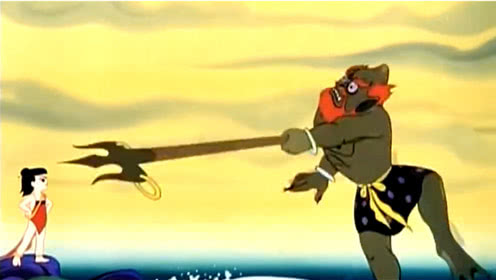

If you are familiar with “Journey to the West” another one of the Chinese fiction classics (5), you might remember this same Dragon King, Áo Guāng (but in that book written as; 敖廣 (Áo Guǎng)), falling foul of 孫悟空 (Sūn Wùkōng) [a.k.a. The Monkey King], when Sūn takes a little side-quest to equip himself with a weapon.

in his 1928 book《太極劍》 (Tàijí Jiàn) [“Taiji Sword”].
(Note the not completely dissimilar posture to the
Xunhai Yecha in the 1979 film still above!)
This sea searching Yecha is the source of my own personal, first contact with the demon character. Many years ago I was researching the 五十四式太極劍 (Wǔshísì shì Tàijíjiàn) [(Yang style) Tai Chi sword form [in] 54 moves], the 38th movement of which was translated as “Night demon explores the sea”. So, as is my wont, I decided to look into the Chinese version of the name for myself. It didn’t take long to see that Night Demon was a corruption of Night Fork, and that the Yang Tai Chi Sword posture name (which I translate as ‘Yecha searches the sea’) is most likely a reference to the Xunhai Yecha from the Nézhà story.
In terms of his characteristics, we should note Lǐ Gèn’s fierce appearance, and that once again he combines protector and predator into a two-fold character; being a protector-henchman in service to the Dragon King, and also a creature that is sent out to steal humans for the Dragon King to eat.
In Closing
A culture’s literature hopefully presents us with a glimpse of how these ideas influence and represent their place within it. Based on the three examples above, you can see that in the Chinese literature version of the Yecha, they transform the two versions of the Indian Yaksha into two sides of a single, more complex character. It is no longer simply a protection spirit or a killer of wayward travellers; now, in various ways, the Chinese Yecha incorporates both these ideas.
I hope you enjoyed this brief look into the world of Chinese literature’s take on the Yecha myth. The concluding part of “Demons” will be published next month.
Notes
- If you know the copyright holders of any of these pictures please let me know.
- Source: “Hidden and Visible Realms: Early Medieval Chinese Tales of the Supernatural and the Fantastic” (Translations from the Asian Classics) by Liu Yiqing & Zhang Zhenjun.
- In the original hanzi version (see translated quote above) you see this; 馬腦 (Mǎnǎo) [Horse’s Brains], which I believe was a reference to ‘Agate’ stone. You could argue that when split, these stones revealed patterns which could be seen as similar to that of a split brain and that is the reason for the name, but I suspect that at some later date the Chinese clarified the hanzi by giving them both a new radical [王 (Wáng) meaning ‘King’, and therefore adding the ‘valuable’ concept], which changed them into this; 瑪瑙 (Mǎnǎo) [Agate].
- The Chīmèi are mentioned as early as the late 4th century BCE in the 《春秋左傳》 (Chūnqiū Zuǒ Zhuàn) [(Mr.) Zuo’s commentary on the Spring-Autumn Annals] tr. Legge (p. 293).
- The four classics of Chinese fiction are;
- 《西遊記》 (Xīyóu Jì) “Journey to the West”
- 《三國演義》(Sānguó Yǎnyì) “The Romance of the Three Kingdoms”
- 《紅樓夢》 (Hónglóu Mèng) “Dream of Red Mansions” (a.k.a. “The Story of the Stone”)
- 《水滸傳》 (Shuǐhǔ Zhuàn) “The Water Margin” (a.k.a. “Outlaws of the Marsh”)
6. This idiom is said to have originated from this line in the Zhuangzi; 「泉涸,鱼相与处于陆,相呴以湿,相濡以沫,不如相忘于江湖。」 “When the springs dry up, and the fish gather on the dry shore, they [are forced to] moisten each other with spittle (mutually help each other in humble circumstances), it would be better for them to forget each other in rivers and lakes.” 莊子, 內篇, 大宗師 (Zhuāngzǐ, Nèi piān, Dàzōng Shī) The Zhuangzi, Inner Chapter; “The Venerable Teacher” (ch.6, section 2) [my translation].
7. Defining Jiānghú is, of course not as simple as that. The term does indeed refer to outlaws (and later gangsters) but the term also referred to itinerant workers & traders, travelling entertainers, fortune tellers, generally anyone operating independently of mainstream society.
8. You can read a free online English translation of Ch.12 of “The Birth of Nezha” (where Nezha kills the Yecha) from “The Investiture of the Gods” here.


Leave a Reply
Want to join the discussion?Feel free to contribute!