
The Legend of Hundun
Introduction
One Chinese legend that has fascinated me since first hearing it, has been the legend of 混沌 (Hùndùn). Húndùn is a figure from Daoist writings that stands as a metaphor for primordial chaos. The 《莊子》 (Zhuāngzǐ) (1), tells Húndùn’s story as the emperor of a land of chaos, situated between two seas, each ruled by their own emperors. It’s an extremely short story, so I’m including my full translation below, and after that I will briefly discuss the symbolism found within it, and expand on the theme of chaos, with its relation to combative strategy, artistic creativity, and the complexities and value of pattern recognition.
The Death of Chaos
南海之帝為儵,北海之帝為忽,中央之帝為渾沌。
The Southern sea had a sovereign called 儵 (Shū),
the ruler of the Northern sea was 忽 (Hū),
and the lord of what lay between was 渾沌 (Húndùn).
儵與忽時相與遇於渾沌之地,渾沌待之甚善。
When Shū and Hū met each other in Húndùn’s land, Húndùn treated them extremely well.
儵與忽謀報渾沌之德, 曰:
Shū and Hū sought to recompense Húndùn’s kindness, saying:
「人皆有七竅,以視聽食息,
“[Every] person has seven apertures [in their head] (two eyes, ears, nostrils, and one mouth),
used for looking, listening, eating and breathing.
此獨無有,嘗試鑿之。」
These [are the] only [things he] doesn’t have. [Let’s] try boring them.”
日鑿一竅,七日而渾沌死。
[So, every] day [they] drilled one hole [into his head], and [on] the seventh day, Húndùn died.
Húndùn is described as a man-like being, with a head that lacks the usual nose, eyes etc. Once we realise that the first character in his name (混, Hùn) also means ‘muddled, or mixed’, it becomes easy to see why his featureless face is often compared to a steamed wonton.

Moving onto the symbolism, we have the seas to the north and south representing 陰 (Yīn) and 陽 (Yáng) – themselves the epitome of fluidity, and their emperors representing the imposing of order over these fluctuating elements. Yīn and Yáng meet in the realm of chaos because it is all that stands between their interplay, and the formation of 太極 (Tàijí). It might amuse fans of “The Immortal Iron Fist” (from Marvel comics), to hear that Prof. Isabelle Robinet once said “…Kunlun (2) (where Iron Fist grew up and learned his Kung Fu) and Hundun are the same closed center of the world.” (3).
The word chaos in English is a Latinization of the ancient Greek; χάος (Kháos). In Greek, χάος means; emptiness, or a vast void / abyss. The ancient Greeks had a creation myth where Kháos was a void state that preceded the creation of the Κόσμος (Kósmos) [Universe]. The idea of the cosmos being created from a state of nothingness is a concept that we have had in the West for quite a while, so long, that there is a well-known latin phrase for it: Creatio ex nihilo [creation out of nothing]. From this we could draw a parallel between Kháos and the Daoist concept of 無極 (Wújí) (as the void state preceding the creation of the universe). The Daodejing tells us that Chaos predates the 道 (Dào) and with it, presumably also Wújí (see the following quote);
有物混成, 先天地生。
[[There was] a thing formed from Chaos,
in existence before Heaven and Earth.]
Daodejing, Ch. 25
Getting back to Húndùn; he had no obvious means of receiving sensory information (4), and as such we could surmise that his mind was a state of emptiness (like Wújí). If this were true, allowing information in would parallel the classic creation of Tàijí in Daoism. Jonathan Z. Smith says that “The mythic chaos, however, is never just equivalent to nothingness…” (5), but I feel that Zhuāngzǐ is not actually equating the two, rather he’s suggesting that a mind of chaos is one filled with unstructured thoughts, unordered by sensory information. Drilling those holes (in a metaphorical sense) could be considered a way of getting sensory information to enter his mind and begin to organise his thoughts. This would destroy the chaos -which he personifies- in his mind, and him with it (just as Zhuāngzǐ described) – literally ‘boring him to death’!
Alternatively you could simply reduce this tale down to a warning to avoid ‘going against a thing’s innate nature’, as Zhuāngzǐ was said to be keen to avoid that.
Chaos is Born of Order
Chaos in cosmogony is all well and good but how does it play out in our lives? Chaos could not be more relevant to the subject of conflict – fighting is inherently chaotic. A ‘melee’ is not only a fight fought hand-to-hand, it has at its origin the verb ‘To Mix’ – just like that first character (混, Hùn) (see above).
In the field of strategy, chaos quickly features in matters of personal, interpersonal, or battlefield combat. It is easy to see how putting your opponent into a state of chaos (or 雞飛狗跳 (Jī fēi, gǒu tiào) [literally: Chickens Flying, Dogs Jumping] as the Chinese might say), would make it easier to gain the upper hand. Six of the 三十六計 (Sānshíliùjì) [36 Stratagems] are dedicated to the application of chaos (6), with the following one perfectly encapsulating this idea;
渾水摸魚, 混水摸魚
(Hùn shuǐ mō yú)
[Disturb the water, to catch the fish]
We can see this same idea in the aphoristic writings of 孫子 (Sūnzǐ) (7), where he says; 「亂而取之」 [“[If the opponent is] in chaos – take him.”] (Ch. 1), and later in chapter five; 「以正合,以奇勝。」 [“Use alignment to unite; use the unusual (or unexpected) to conquer.”] The impact of preconceptions and expectations on the inspiration of chaos should not be overlooked. If the opponent is expecting certain behaviours and we behave very differently to that, it can be confusing, especially if the opponent fails to comprehend any sense of reason for your actions. Defying reason is the definition of ‘chaotic’.
Sūnzǐ’s “The Art of War” is often falsely attributed with this popular quote on chaos; “In the midst of chaos, there is opportunity.” However, I couldn’t find anything in the Sūnzǐ which bears even a close resemblance to that. It sounds more like a corruption of the oft-quoted breakdown for the Chinese word for ‘Crisis’. 危機 (Wēijī) [Crisis] as a word, consists of two characters, and if we take them separately the first one means ‘Danger’, the second: ‘Opportunity’. This certainly suggests that whoever created the written form believed both danger and opportunity are potential outcomes of a critical moment of crisis, but though being in the midst of crisis or chaos are arguably similar, they are not the same thing.
Putting your opponent into a state of chaos is one thing, but Sūnzǐ also warns of the dangers of succumbing to it yourself. A great illustration of his succinct repetitive parallelism, this line sits as the first of a trio of contrasting lines relating his position on noteworthy obstacles to successful troop control.
亂生于治, (Luàn shēng yú zhì)
[Chaos is born of Order]
Sūnzǐ, Ch. 5
The solution to this chaos, which he offers soon after (see the following quote), suggests that the difference between having order or chaos within your ranks, is simply a matter of keeping account of them.
治亂數也。 (Zhì luàn shǔ yě)
[[Whether you have] Order [or] Chaos [is a matter of] logistics.]
Creativity & Patterns
Philosophically speaking, the idea of chaos as a source of creation is not limited to cosmogony, it can also apply to ideas and creative endeavours too. Mixing stuff up is a classic concept in art, for example. Salvador Dali’s surrealist paintings draw us into chaotic looking realms, but Kayla Mahaffrey’s works, for me, bring together the simple creativity of how children imagine things, with a playful slice of realism. This is how I imagine a chaos realm would look like – a mash-up of reality and order with random images of fully or partially formed (or themselves mixed) things.
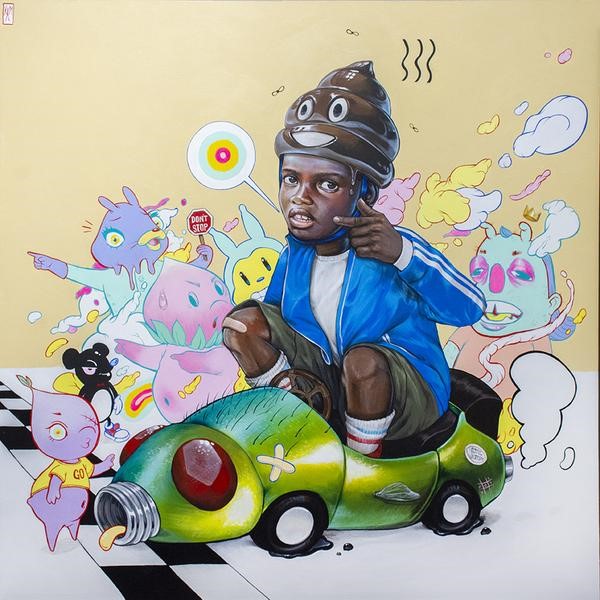
Chaos featuring in creativity is not same as creation born from chaos, for that, the cut-up technique popularized by the American writer William S. Burroughs in the 1950s/60s springs quickly to mind. The idea is to take words on separate pieces of paper, pick a random selection and lay them out in front of you. Maybe you use the words in the order they appear, maybe not, the order is not important. You could take inspiration from a single word, the order in which they appear, or whatever word combination comes to mind instead. The method is not as important as the inspiration you are seeking from it. The cut-up technique leads the mind to try and seek a sensical connection between unrelated things, seeing patterns of meaning where we know there were none planned.
In 1958, the field of psychiatry gave us a word for how our minds’ want to seek out patterns: ‘Apophenia’. A clear example of Apophenia working overtime is when gamblers start seeing ‘winning’ patterns, or conspiracy theorists start making connections that aren’t there. The human ability to see patterns sits at our core, in pre-historic times this would keep our ancestors alive. When ‘those colourful berries’ started to give every one in the tribe a dodgy tummy, we would eventually just spread the word that they were poisonous. But before we could do that, we had to see the connection between a dodgy stomach and those pesky berries.
The idea then, that ‘Chaos describes our inability to see a pattern’ becomes an interesting one. Is a thing chaotic simply because we are unable to make the connection to a reason for the behaviour? In scientific Chaos Theory, it is said that although the formulas which create complex systems can be simple, if they are a system that involves feedback and evolution, they are completely unpredictable (9).
You could, look upon the confusion aspect of chaos, as reality failing to match our preconceptions / expectations; failing to see the patterns. To return briefly to strategy, we have Sūnzǐ pointing out that an experienced commander cannot get flustered by chaos, as it is always present in combat. Failing to see patterns as quickly as they emerge will mean defeat;
紛紛紜紜,鬥亂,而不可亂也。
[[Though] confusing and disorderly, fighting is [always] chaotic,
so [this] should not confuse [you].]
渾渾沌沌,形圓,而不可敗也。
[Chaos and confusion, [have a] circular form, so [they] should not defeat [you].]
Sūnzǐ, Ch. 5
Understanding how chaos and confused behaviour can circle around and repeat itself (to me at least) sounds extremely difficult to pull off. If you were to apply this idea to fighting an irratic opponent, you would see that it is rare that they can sustain an endless array of never-repeating techniques. Sooner or later they will repeat techniques and generally they will tend to favour their ‘go to’ moves. I suspect this is what Sūn is referring to. The opportunity to see patterns through repetitions, will require that you have good observation skills, an excellent memory, and that you stay in the fight long enough.
In Closing
Can we escape chaos? The Daodejing says that the moment we recognise beauty, we create ugliness, and as soon as everyone says what is good – so, bad is born (10). I think it is the same with Chaos and Order. We can try to minimise chaos all we want, but as long as we have order, chaos will, at some point rear its featureless head. The best we can do is prepare for it.
Further Reading
If you would like to further explore the Húndùn legend, I would recommend; “Myth and Meaning in Early Daoism – The Theme of Chaos (Hundun)” (1983), by N. J. Girardot.
Notes
- 《莊子》 (Zhuāngzǐ) c. 3rd century BCE. Húndùn’s story comes at the end of chapter seven.
- 崑崙 (Kūnlún)
- “The Encyclopedia of Taoism” (2007), p.525, Isabelle Robinet.
- I recognise that a sense of touch would still be available to Húndùn, as well as things like proprioception (a sense of the body’s position), equilibrioception (balance), interoception (the internal state of the body), and nociception (pain), but I feel that Zhuāngzǐ is symbolically trying to indicate a general absence of classic sensory input. It would be weird to read Zhuāngzǐ saying “Oh, and yeah, touch as well – forgot that.”
- “Map is Not Territory: Studies in the History of Religions” (1978), p.97-98, by Jonathan Z. Smith, University of Chicago Press, ISBN: 9780226763576.
- 三十六計 (Sānshíliùjì) [36 Stratagems], chapter four: 混戰計 (Hùn Zhànjì) [Chaos Stratagems]
- 《孫子兵法》 (Sūnzǐ Bīngfǎ) [“The Art of War” (lit. The Military Methods of Sūnzǐ)] c. 5th century BCE.
- You can check out (and support!) the beautifully, chaotic art of Kayla Mahaffrey here.
- I may have misunderstood this, as I am no scientist, but for a better idea of what I’m trying to say, I would thoroughly recommend; “The Secret Life of Chaos” by Prof. Jim Al-Khalili (2015). It’s a very accessible BBC 4 documentary about scientific Chaos Theory. Here’s one way to see it.
- 《道德經》(Dàodéjīng), 老子 (Lǎozǐ), c. 6th century BCE – chapter two.


Leave a Reply
Want to join the discussion?Feel free to contribute!